


Description
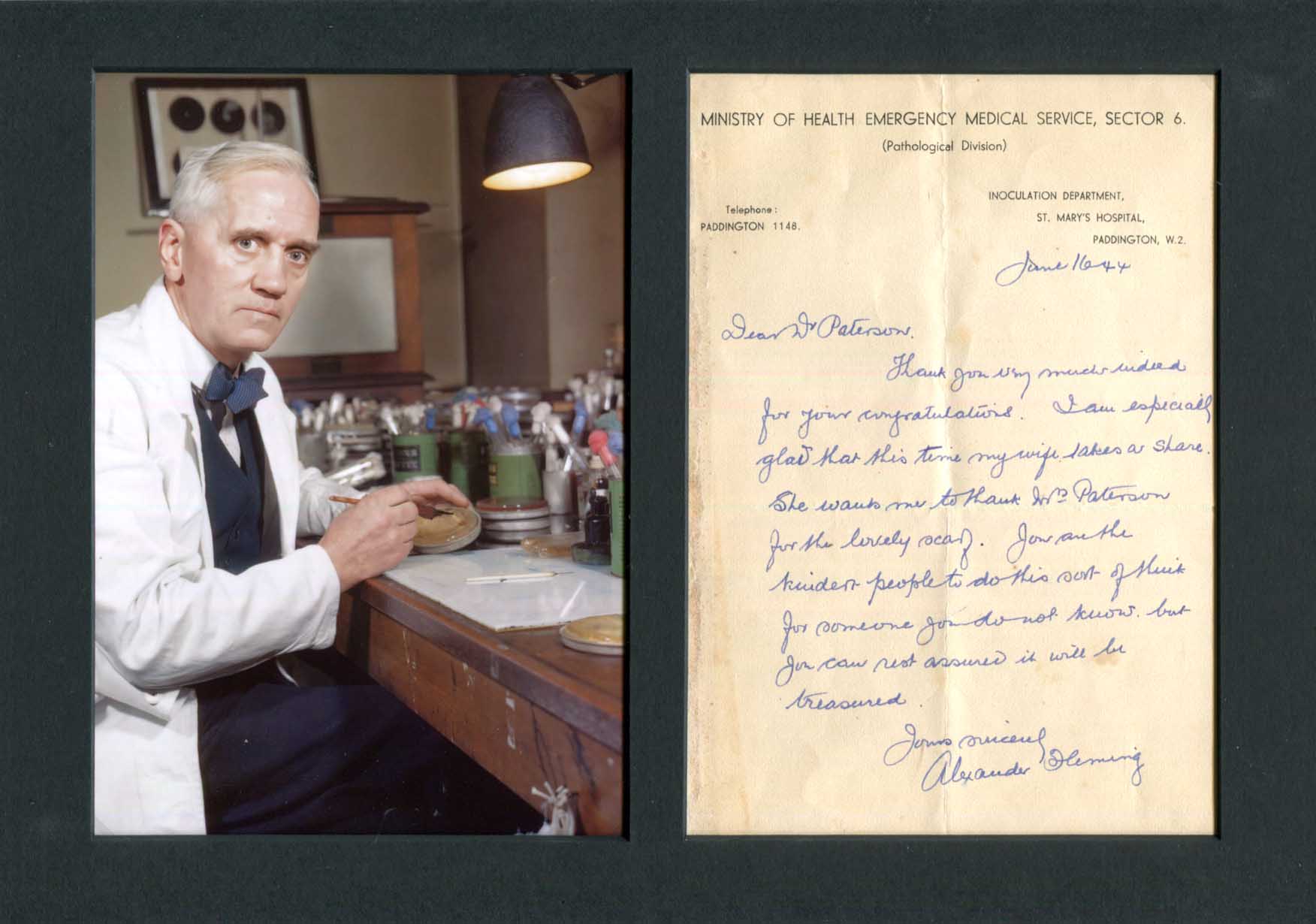
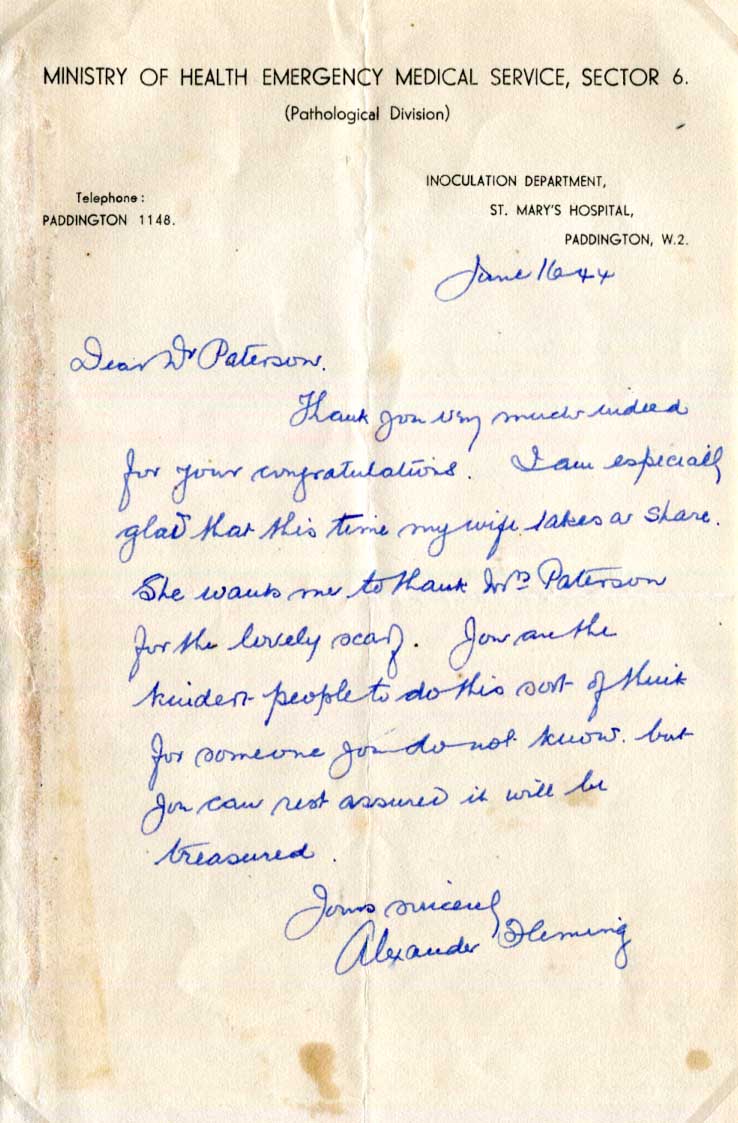
Autograph letter signed, one page, 5 x 7,5 inch, (Paddington), 16.06.1944, `Ministry of Health Emergency Medical Service, Sector 6.` stationery, to a Dr. Paterson - Fleming thanks the Dr. for his congratulations and the scarf sent to his wife by Mrs Paterson, written and signed in blue ink "Alexander Fleming", attractively mounted (removable) for fine display with a photograph of Fleming in his laboratory (altogether 11,75 x 8,25 inch), with intersecting letter folds, traces of former mounting, and mild soiling - in fine condition.
"Dear Dr. Paterson,
Thank you very much indeed for your congratulations. I am especially glad that this time my wife takes a share. She wants me to thank Mrs. Paterson for the lovely scarf. You are the kindest people to do this sort of thing for someone you do not know, but you can rest assured it will be treasured.
Yours sincerely, - Alexander Fleming"
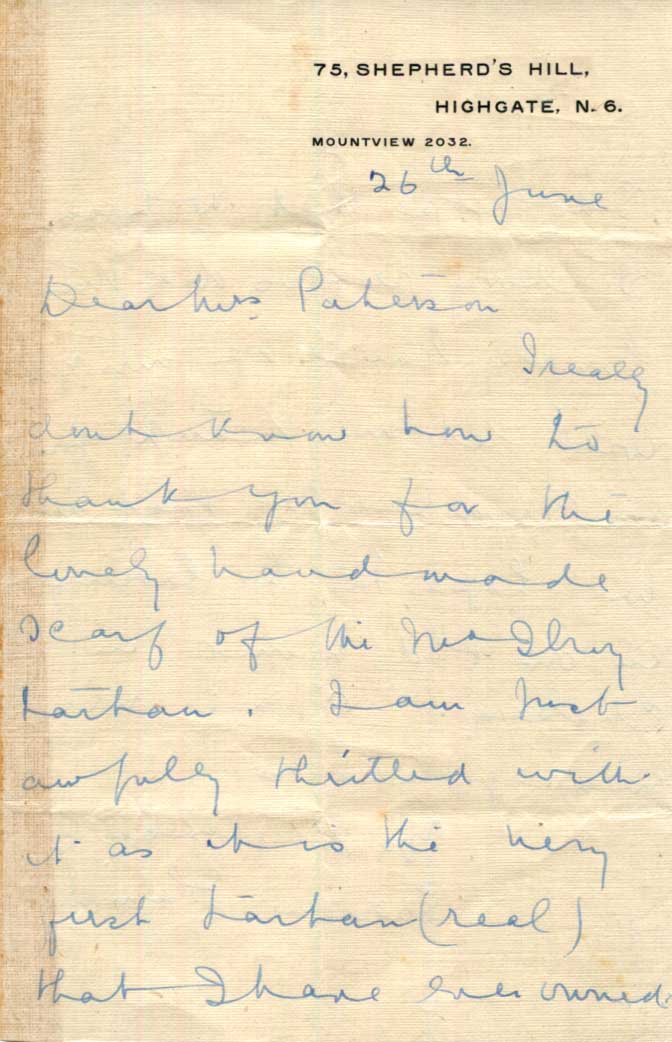
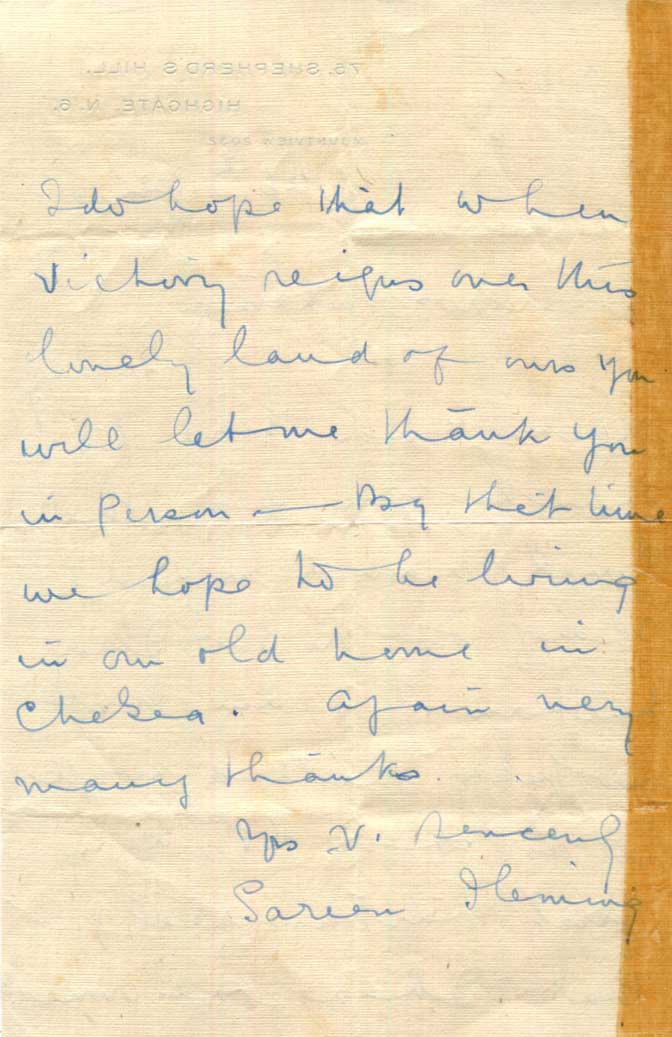
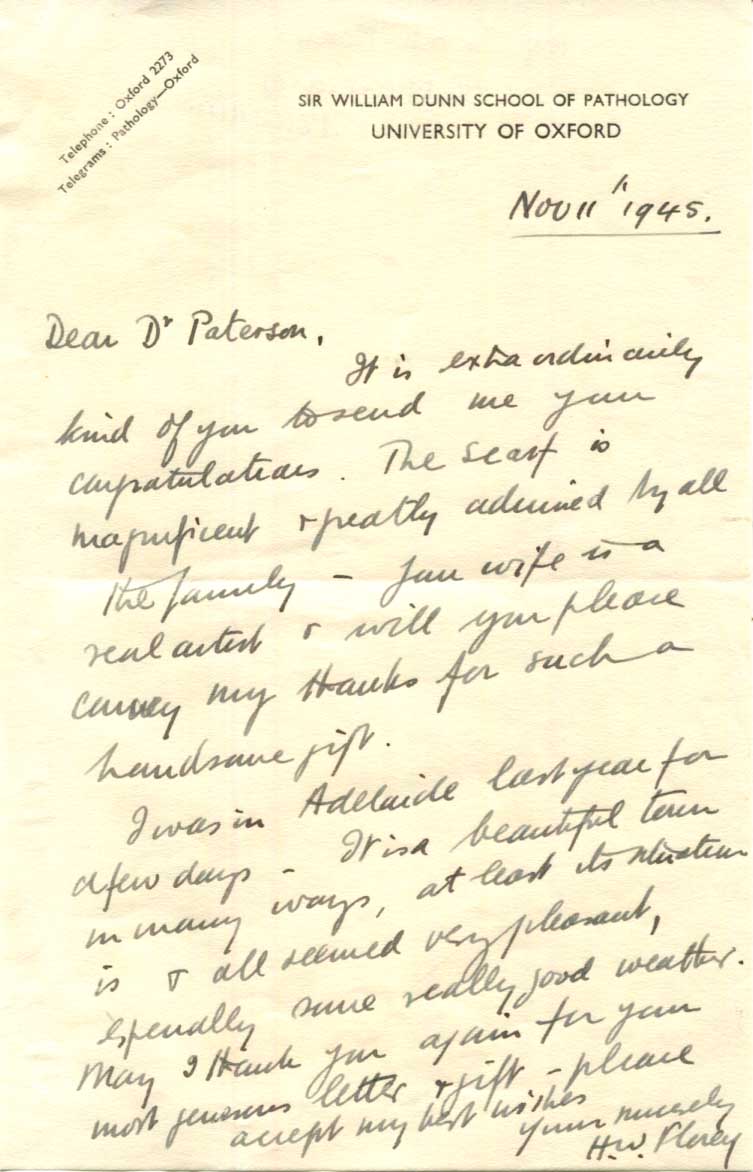
Accompanied by a two page autograph letter signed from Mrs. Fleming to Mrs. Paterson giving effusive thanks for the scarf and saying that she would like to thank in person "when victory reigns over this lovely land of ours". Also accompanied by an ALS from H. W. Florey the Australian pathologist who succeeded in isolating the drug Penecillin which Fleming had accidentally discovered - also to Dr. Paterson (Nov. 11, 1945) and once again thanks him for a scarf and for his congratulations (possibly on his award of the Nobel Prize for Medicine which he won with Fleming and Ernst Chain that year).
Further Information on the person
Profession:
(1881-1955) Scottish physician and microbiologist, best known for discovering the world's first broadly effective antibiotic substance, which he named penicillin - he shared the Nobel Prize in Physiology or Medicine in 1945 with Howard Florey and Ernst Boris Chain.
Year of Birth: 1881
Alexander Fleming was a Scottish biologist and pharmacologist who is best known for his discovery of the antibiotic penicillin in 1928. Born on August 6, 1881 in Lochfield, Scotland, Fleming grew up on a farm and showed an early interest in science. He studied medicine at St. Mary's Hospital Medical School in London and later served as a captain in the Army Medical Corps during World War I.
After the war, Fleming returned to his research at St. Mary's and began studying the properties of bacteria. In 1928, he made the discovery that would change the course of modern medicine: the antibiotic penicillin. Fleming observed that a mold called Penicillium notatum had antibacterial properties that could kill a wide range of disease-causing bacteria.
Fleming's discovery of penicillin revolutionized the treatment of bacterial infections and earned him the Nobel Prize in Physiology or Medicine in 1945. He continued to work in the field of microbiology and made several other significant contributions to medicine throughout his career.
In addition to his work on penicillin, Fleming also conducted research on other antibiotics and vaccines. He died on March 11, 1955 in London, leaving behind a lasting legacy as one of the pioneers of modern medicine.
Today, Alexander Fleming is remembered as a groundbreaking scientist whose discovery of penicillin has saved countless lives and transformed the field of medicine. His work continues to inspire researchers and medical professionals around the world.
In recognition of his contributions to science, Fleming's work is commemorated in numerous ways, including statues, awards, and institutions named in his honor. His legacy lives on as a testament to the power of scientific discovery and the impact it can have on society.
Certificate of authenticity
All of our pieces are sold with a Certificate of Authenticity. If a piece turns out to be wrong or if you do not like an autograph, you will get your money back for a lifetime.
Payment & Security
Your payment information is processed securely. We do not store credit card details nor have access to your credit card information.