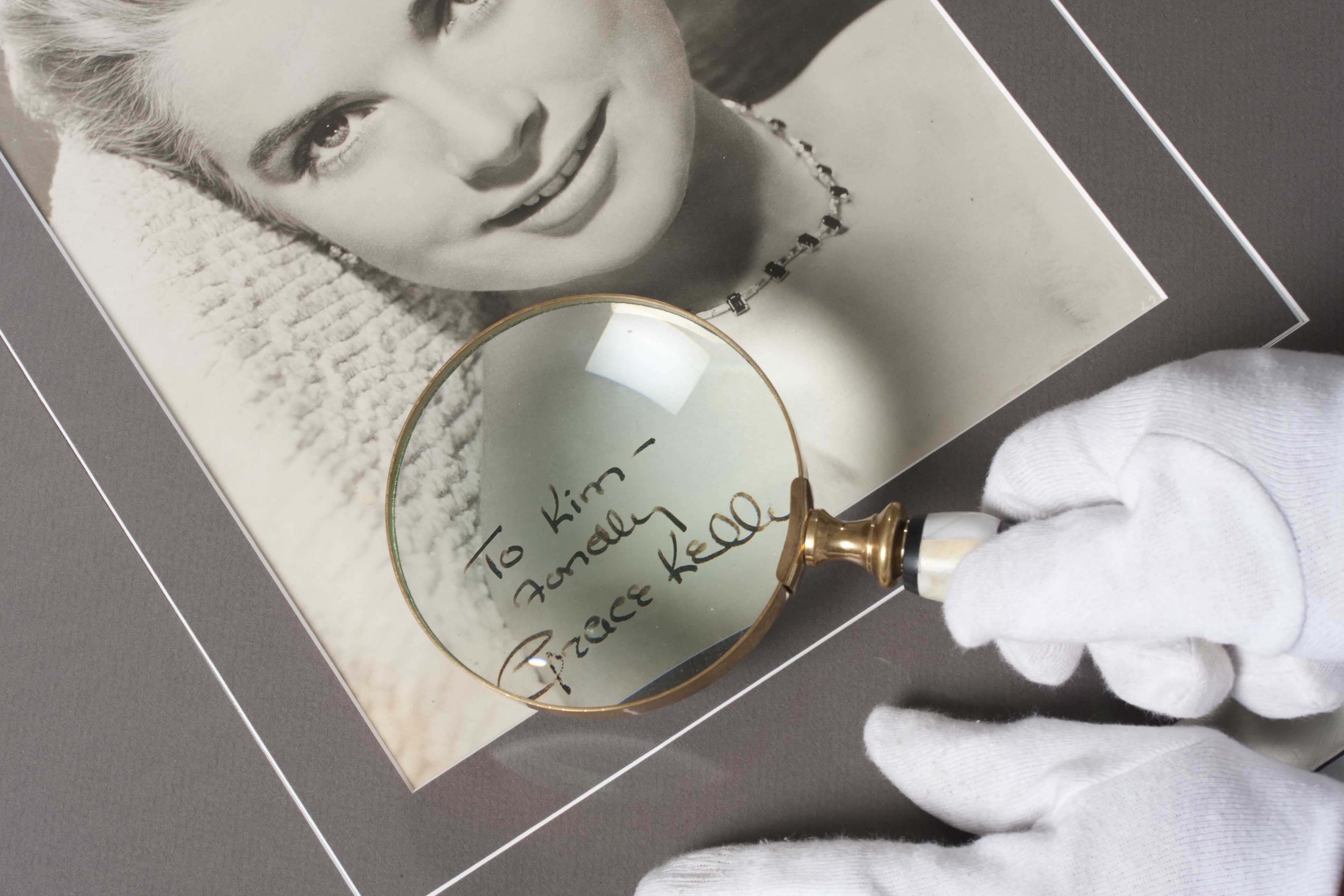
If an autograph seems too good to be true, it probably deserves a closer look.
There is no single visual trick that can prove an autograph is genuine in every case. The safest autograph is one obtained personally from the signer, but collectors usually have to judge pieces long after the signing took place. This guide brings together practical observations from many years of handling autographs, signed photographs, letters and manuscripts.
For collectors, the most useful approach is not to rely on one detail alone. Look at the signature, the writing instrument, the surface, the age of the photograph or document, the provenance, and the context in which the autograph was supposedly signed.
Quick checklist before buying an autograph
- Compare the signature with proven examples from the same period.
- Look for natural writing flow, pressure, variation and pen lifts.
- Check whether the ink, pen and paper fit the claimed date.
- Be cautious with signatures that look drawn, hesitant or mechanically even.
- Ask for provenance: when, where and how was the autograph obtained?
- Consider whether a secretary, rubber stamp or autopen could have been used.
- Buy from an established dealer who stands behind the item.
Why autograph authentication is difficult
Every signature has character: angle, rhythm, pressure, spacing and proportions. At the same time, genuine signatures can vary. A relaxed private signing may look different from a hurried signature obtained at a premiere, race day, stage door or public event. Age, illness, writing surface and the object being signed can also change the appearance.
This is why comparison is essential. A single genuine example is helpful, but a group of reliable examples from the same period is far better. Whenever possible, compare like with like: a signed photograph with signed photographs, letters with letters, and items from roughly the same decade.
Rubber stamp signatures
A rubber stamp signature is produced from a carved or manufactured impression of a handwritten signature. It can be applied to paper, photographs or postcards and may look convincing at first glance, especially on dark photographs where the ink is difficult to judge.
Stamped signatures often have a drawn look and uneven ink distribution. They may lack the natural pressure and movement of handwriting. In the entertainment field, rubber stamped signatures were widely used on fan mail and promotional photographs. Many so-called signed photographs of early film stars should be examined with particular care.


Secretarial signatures
A secretarial signature is written by another person on behalf of the celebrity or public figure. It may be done by a secretary, family member, studio employee or office assistant. These signatures can be very difficult because they are handwritten and may imitate the genuine signature closely.
Secretarial signatures are common in several collecting fields, especially presidents, political figures, film stars and other public personalities who received large amounts of correspondence. Once a secretary learned a signature, they often repeated the same habits. A small difference from the genuine hand can therefore become a repeated clue.
The best protection is reference material. Without known authentic and known secretarial examples, certainty is often impossible. Collectors should be particularly careful with fan-mail photographs and formal responses from very busy public figures.
Autopen signatures
An autopen is a machine that reproduces a signature using a real pen. This makes autopen signatures more deceptive than printed facsimiles: the mark is made with ink, but not by the hand of the signer. Autopen use became especially common from the mid-20th century onward among politicians, astronauts, celebrities and offices dealing with large volumes of correspondence.

Possible warning signs include:
- perfectly even ink flow from beginning to end;
- little or no variation in pressure;
- unnatural curves or squiggles;
- abrupt stops;
- a signature matching another example exactly in shape and rhythm.
The most reliable way to identify an autopen signature is comparison with a known autopen pattern. Minor differences can occur if the paper moved during the process, but exact matches in important parts of the signature are a serious warning sign.
Shaky writing and hesitation
A natural signature is usually written in seconds. It should generally show movement and confidence, even when the signer is elderly or the surface is difficult. A forged signature often looks slow, careful or laboured. The first letter may be shaky, the pen may stop in unusual places, or the final stroke may end abruptly instead of trailing naturally.
There are exceptions. Illness, age and pressure can affect genuine handwriting. The point is not that every shaky signature is false, but that unnatural hesitation should always be investigated.
Dating clues: pens, ink and photographs
The materials must fit the story. Fountain pen, pencil, ballpoint, felt tip and metallic markers all belong to different periods and contexts. A signature supposedly from an early date but written with a later writing instrument should raise questions.
| 1845 | Early carte de visite photographs |
| 1860s | Common letter formats and folded correspondence |
| 1900 | Photographs from postcard size to 8x10 inches become more common |
| 1920s | Large 11x14 inch photographs become more common, especially in film |
| 1940s-1950s | Ballpoint use becomes increasingly common |
| 1960s | Felt-tip pens become popular |
| late 1970s-1980s | Sharpie and metallic markers become familiar |
Signed photographs should also be judged by format and production date. A cabinet photograph, postcard, vintage studio portrait, 8x10 glossy photograph and later colour print each belong to a different collecting context.
Film and celebrity photographs
Film and entertainment autographs are especially exposed to facsimiles, secretarial signatures, rubber stamps and later additions. Small fan-mail photographs were often sent out in large quantities. Larger photographs, inscriptions and clearly personal presentation pieces can sometimes be more promising, but each item must still be judged individually.
Collectors should be cautious with very famous names on standard promotional photographs, especially if the signature looks too neat, too identical to other examples, or out of context for the period.
Buying from established sources
Whenever possible, buy from a well-established and reliable source. You may pay more for a carefully vetted autograph, but you gain something important: experience, accountability and a dealer who stands behind the item.
At Brandes Autographs we handle autographs, signed photographs, letters, manuscripts and documents across many collecting fields. Each item is checked before it is offered, supplied with a certificate, and backed by our lifetime guarantee of authenticity.
Browse current autographs or use our Search Notification if you are looking for a particular name or collecting field.
FAQ
How can I tell if an autograph is genuine?
Start by comparing it with reliable examples from the same period. Check writing flow, pressure, ink, paper, photograph type, provenance and whether mechanical or secretarial signing is likely.
What is an autopen signature?
An autopen signature is created by a machine using a real pen. It can look handwritten, but the signer did not personally write it.
What is a secretarial signature?
A secretarial signature is written by another person on behalf of the celebrity or public figure, often by a secretary, assistant or office staff member.
Are signed photographs more likely to be forged?
Signed photographs are a popular collecting field and therefore attract forgeries, facsimiles and secretarial signatures. Film and celebrity photographs need especially careful examination.
Is a certificate enough?
A certificate is only as reliable as the person or company issuing it. It should be supported by experience, comparison material and a clear guarantee.
Written and updated by Markus Brandes, Brandes Autographs.