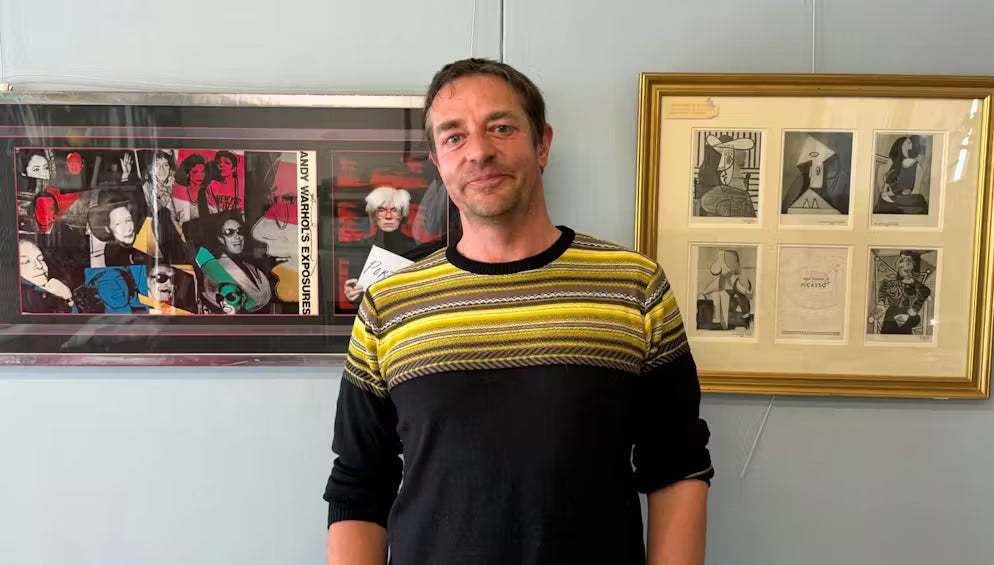
On the walls of the hallway, pictures and autographs of personalities like mobster Al Capone, musician Bob Marley, and missionary Mother Teresa line the space. A tour book from the band Pink Floyd is also on display. They are all originals that Markus Brandes has collected over the past 40 years. But Brandes is not a fan—or not just one—collecting signatures is his profession. He is a so-called autograph dealer—or a "handwriting nerd," as he describes himself. This means he specializes in sourcing, authenticating, evaluating, and selling the signatures of famous personalities.
Among other things, he specifically searches for highly sought-after autographs for his clients, visits estates, mediates between buyers and sellers, attends auctions, and takes on numerous other tasks within the collector's market. He has been working with some clients for many years, while others purchase pieces directly through his website. However, it also happens that items are offered directly to him.
His passion began at a very young age. At 13, he started collecting signatures from soccer players. He wrote letters to the clubs. "A few autograph cards came back from FC Bayern Munich, and I was absolutely thrilled," Brandes recalls. "This fascination hasn't let go of me since ." Autographs were also collected and traded among his circle of friends, similar to Panini stickers. Eventually, he had all the cards his friends could offer him. So, he began writing letters abroad to obtain signatures from celebrities there. "I spent all my pocket money on postage," says Brandes. He sold his duplicate copies, which is how he earned his first money. Even today—30 years later—he still makes his living from it. At the age of 21, he went into business for himself as an autograph dealer.

Originally from Germany, Brandes has been living in Switzerland for 15 years now. His office is located in Güttingen (Thurgau), a small community directly on Lake Constance. He now employs two staff members: a historian and a person responsible for packaging and shipping orders.
According to Brandes, collectors can be roughly divided into three types: The first is the classic fan. This type focuses on a single person who has shaped them, such as a sports idol, a historical figure, or a scientist. For these collectors, the emotional connection is paramount, which is why they specifically collect personal items like signatures or memorabilia. The second type is less interested in individual people and more in entire subject areas. This could be film history, Nobel Prize winners, or handwriting in general; these collectors systematically build extensive collections. Finally, the third type views autographs and manuscripts as an investment: historical originals gain value over the long term due to their uniqueness and rising demand, especially during anniversaries or in connection with significant events. "I'm a little bit of all three," the 49-year-old says with a laugh.
Brandes loves handwriting. When he speaks about it and his profession, he can hardly be stopped. He opens a binder on the table. Inside are hundreds of signatures, letters, photos, and autographs with personal dedications from famous people like racing drivers, astronauts like the Swiss Claude Nicollier, or former Federal Councillor Adolf Ogi. Brandes knows the story behind every single piece. Finally, he opens a page that particularly stands out: an original letter by the French statesman and former Emperor Napoleon, in which he considers a potential capitulation for the very first time.
"Through handwritten texts and private correspondence, I get to know a person in a completely different way than through a finished book or a movie," he explains. "You discover a personal or even completely unknown side of a person that you find fascinating ." Brandes owns letters not only from Napoleon, but also from Albert Einstein, Al Capone, the physician and philosopher Albert Schweitzer, and other historical figures. Added to this are countless autographs from boxer Muhammad Ali, singer Elvis Presley, musician Amy Winehouse, and many other icons. The list could go on almost endlessly. Currently, his inventory includes around 8,000 original signatures, with about 20,000 pieces in stock. "However, the quantity isn't of great significance, because quantity is not quality," Brandes says.

Contemporary names can also be found in his assortment: singer Taylor Swift, actress Emma Watson, former tennis pro Boris Becker, the late One Direction singer Liam Payne, and many more. Prices start at five francs and reach up to several thousand francs. The most expensive object he was ever involved with: he mediated around 1,200 letters from the estate of Emmy Martin to the Albert Schweitzer Archive for 300,000 francs. Martin was Schweitzer's secretary and confidant.

Yet, the question of the most expensive object is almost impossible to answer, because: "Some pieces have great personal value to me, but not a correspondingly high market price," says Brandes. He is particularly fascinated by items like the Pink Floyd guest book hanging in his hallway. In it, the band documented, among other things, their expenditures on drug consumption during their tour. Or a signed record by Bob Marley, including a mixing bowl, created during a phase when his cancer was no longer treatable in Germany. It is one of the last written documents from that period. "There is a story behind it that fascinates me," says Brandes. For him, the value often lies in the context: "It arises when I have gotten to know the person, when there is a connection to history, or when an object is unique in some way and tells more than just a signature."

He sources the autographs through auctions, by mail, or via so-called autograph hunters. These are people who deliberately track down celebrities or attend events to collect signatures and later resell them. For this, Brandes relies on an international network: trusted contacts in cities like Los Angeles, Paris, or London have excellent connections, access to celebrity parties, move along the red carpet, or are networked with people who provide tips on where stars are currently staying—such as their chauffeur.
However, he does not accept every offer: for instance, he once received an email directly from Sylvester Stallone's doctor offering three videos of the birth of Stallone's children. He declined—partly for ethical reasons, and partly because he intentionally concentrates on written documents. Brandes is drawn to the enduring—writings that remain relevant and carry history even years down the road. "It becomes truly exciting for me when I can serve people who have been looking for something for years, and I can give them exactly that," says Brandes. "When a collector has been searching for a specific handwriting for ten years to complete their mosaic, and you find and mediate that piece, the price almost fades into the background. It is simply an incredibly emotional business," he continues. This also creates a close bond with customers because you immerse yourself in their passion. "For one person it is trivial, for another it can mean the world."
Brandes himself spends a lot of time in front of the computer, tracking relevant offers worldwide. He visits trade fairs, reviews estates, and examines signatures for authenticity. Additionally, he is regularly called upon as an expert, including on shows like "Bares für Rares" ( tedesco equivalent of Cash or Trash), and is a member of the Federal Association of Handwriting Experts (Bundesverband der Schriftsachverständigen). But it doesn't stop there: Brandes writes books and reference works on handwriting and is actively engaged in the fight against autograph forgeries. "I'm a nerd in this field," he says.
This is also why he collaborated with astronaut Buzz Aldrin. The background was a British seller who had forged numerous autographs of Aldrin as well as other space travelers like Michael Collins. Brandes supported the investigation and helped convict the fraudster. In court, Aldrin ultimately confirmed that the signatures were fakes. As a thank you, Brandes received a personally signed dedication from the astronaut.
By now, Brandes often recognizes forgeries within a few minutes, if not seconds. "After 30 years of professional experience, you have held countless pieces in your hands. Furthermore, we have access to more than one million reference signatures that we can consult depending on the time and era," he explains. There are minimal differences that change in handwriting over time. Brandes pulls another thick binder from a shelf and points to a signature by actor and comedian Charlie Chaplin. "This one here, for example, was made with a rubber stamp," he explains. In one spot, the ink is significantly stronger than in others. Moreover, a comparison with other signatures shows that they match to the exact millimeter when you place a ruler against them. This is also a sign that a stamp was used. Many celebrities resorted to this method because it saved time. While it is not a forgery per se, it is just as little an authentic signature.
"Hardly anything is as characteristic as handwriting and signatures," says Brandes. Anyone who compares several authentic examples from the same phase will recognize recurring features. For instance, a letter is not suddenly shaped completely differently, and details like dots or dashes usually follow fixed habits. "There are an incredible number of characteristics in handwriting that always remain the same," says Brandes. Using this combination, authenticity can be verified, and sometimes even the period of creation can be narrowed down. With autographs of the Beatles, for example, he can determine the timeframe to within a few months based on typical developmental characteristics of the individual signatures. If characteristic elements that are always present in comparable patterns are missing, it raises doubts about authenticity.
However, the industry has also changed fundamentally over the last 30 years. The classic autograph is becoming less interesting; instead, the selfie is what counts. "The enthusiasm for personality has changed. Many stage themselves on social media and see themselves as celebrities," says Brandes. Instead of owning a signature, people might follow their idol online. Collecting itself has also changed. In the past, people combed through flea markets and trade shows, and with a bit of luck, discovered rare pieces whose value was often only recognized by insiders. Today, almost everything can be researched in seconds. The classic "bargain" is much harder to find.
Artificial Intelligence (AI) has brought a new challenge to the mix: the question of provenance—meaning proof of authenticity and origin. With the rise of AI, not only forged signatures are created, but also deceptively real photographic evidence. "I owned an allegedly signed record by Michael Jackson, but I had doubts about the authenticity of the signature," Brandes shares. "Later, I received a photo that supposedly showed Jackson holding and signing exactly this record ." But the picture turned out to be AI-generated. Photo evidence is thus increasingly losing its validity and becoming harder to verify.
But of course, Brandes does not let this discourage him. He faces the new challenges, can count on a loyal customer base, and is already pursuing further plans: currently, the opening of an auction house in Germany is in preparation.
"Signatures are not just fan merchandise, but a connection to another time," he says. "They make it possible to dive into the past and experience it in a very unique way."
Written by
Published (in German):
https://www.bluewin.ch/de/entertainment/es-ist-ein-unglaublich-emotionales-geschaeft-3200185.html