
Autograph collecting in its modern sense developed from the Renaissance tradition of friendship albums, expanded through the manuscript culture of the eighteenth and nineteenth centuries, and became a popular international hobby in the twentieth century. Its history is not a simple progression from ancient signatures to modern celebrity collecting. It is the history of changing attitudes towards handwriting, memory, scholarship, fame and the preservation of original documents.
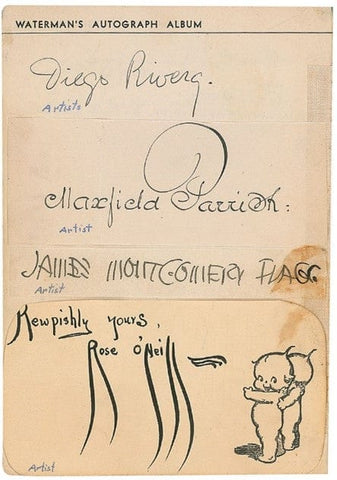
I began looking more closely at this subject after examining a small Waterman autograph album with its original advertising and contest material. The album belonged to one of the most remarkable organised collecting campaigns of the twentieth century. In 1932, the L. E. Waterman Company encouraged children across the United States to collect the signatures of notable people. Contemporary reports estimated that approximately 150,000 young collectors participated.
For an autograph dealer, such an album is more than an assortment of names. It records how collecting was practised at a particular moment: whom people considered important, how signatures were requested, how albums were arranged and how commercial companies helped shape the hobby.

What is an autograph?
The word autograph derives from Greek roots meaning something written in a person's own hand. In collecting, however, the term covers several distinct kinds of material. A simple signature is an autograph, but so is an autograph letter written and signed by its author. Collectors may also encounter signed documents, manuscripts, musical quotations, inscriptions in books, signed photographs and entries in friendship albums.
This distinction matters. A signature cut from a document preserves a name, but usually loses its original purpose. A complete letter preserves the handwriting together with the date, recipient, content and historical circumstances. Modern collectors increasingly value this context, and rightly so.
Ancient writing and the limits of the evidence
Writing authenticated authority long before autograph collecting became a recognised pursuit. Rulers, officials and private individuals used handwritten names, marks and seals to validate acts and agreements. Greek and Roman manuscripts also survive in libraries and archaeological collections.
It would nevertheless be misleading to describe this as autograph collecting in the modern sense. Documents were preserved because of their legal, religious, administrative or literary importance, not necessarily because somebody wished to own the handwriting of a celebrated person. Nor can a continuous collecting tradition be traced from classical antiquity through the Middle Ages. The evidence becomes much clearer in early modern Europe.
The Renaissance and the album amicorum
One of the most important ancestors of the autograph album was the album amicorum, also known in German as a Stammbuch. These friendship albums became especially popular among students, scholars, diplomats and noble travellers in the sixteenth and seventeenth centuries.
Owners invited friends, teachers and prominent acquaintances to contribute a motto, dedication, coat of arms, drawing or signature. The result was both a record of friendship and a visible network of social and intellectual connections. Surviving examples in the British Library document albums compiled across Germany, France, England, Switzerland and the Netherlands during the early seventeenth century.
These volumes are valuable historical sources. They preserve names that might otherwise be forgotten, record journeys and university contacts, and sometimes contain original drawings by significant artists. Their purpose was personal, but their evidential value is now scholarly.
From remembrance to historical collecting
During the eighteenth and nineteenth centuries, manuscript collecting became increasingly systematic. Scholars, antiquarians and private collectors sought the handwriting of writers, composers, rulers, military figures, scientists and political leaders. Handwritten material was valued both as a personal relic and as evidence for biography and history.
Major collections were formed in Europe and the United States. Johann Wolfgang von Goethe, Karl August Varnhagen von Ense and Stefan Zweig are among the best-known names associated with the collecting and preservation of manuscripts and autographs, although their interests and methods differed considerably.
In the United States, the Reverend William Buell Sprague became famous for assembling autograph material connected with the signers of the Declaration of Independence. The history of his collecting also illustrates a practice that modern archivists view critically: removing letters from larger bodies of correspondence. The Library of Congress records that material once separated from George Washington's papers later entered several collections.
This is an important lesson in the history of the trade. Earlier collectors often removed signatures, pages or passages from documents in order to arrange names alphabetically or complete a set. Today, an intact document with its original context is normally preferable to a clipped signature. Preservation standards have changed because our understanding of historical evidence has changed.
The rise of specialist literature and the autograph trade
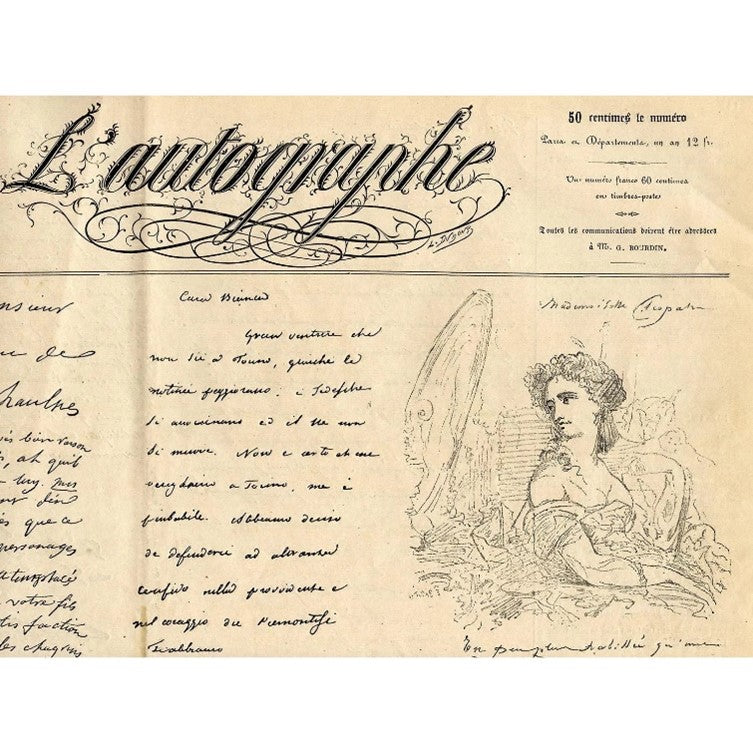
By the nineteenth century, autograph collecting had developed its own literature, catalogues, dealers and auctions. Handbooks advised collectors on terminology, arrangement and authenticity. Auction catalogues circulated descriptions of letters and manuscripts to an international audience.
Germany and France were particularly important centres. Specialist firms and auction houses helped establish methods of description that remain recognisable today: the identification of the writer and recipient, the date and place of writing, the number of pages, the language, the subject matter and the condition of the document.
These details are not merely commercial. They are the foundation of responsible cataloguing. A historically useful description should allow the reader to understand what the object is, why it matters and which claims can be supported by the document itself.

The Waterman autograph contest of 1932
The Waterman campaign offers an unusually well-documented view of autograph collecting as a mass hobby. The contest ran for six months in 1932 and was open to boys and girls under the age of sixteen. Participants filled specially produced albums with the signatures of notable people and submitted them for judging.
A contemporary report in Time estimated that approximately 150,000 children took part and that more than one million signatures were submitted. The New Yorker reported from the judging at the Waldorf-Astoria and described the winning album of Thomas Leonard of Lincoln, Nebraska. Its approximately 150 names ranged across politics, literature, entertainment, sport and public life.
The contest offered 333 prizes, including a first prize of $1,000 as well as Waterman pens and mechanical pencils. It was ingenious advertising, but it also reveals the extraordinary reach of autograph collecting at the time. Children wrote to public figures, approached local celebrities and learned to distinguish personal signatures from secretarial replies, rubber stamps and printed facsimiles.


The surviving albums differ greatly in quality. Some contain only a few local names; others include presidents, writers, aviators, actors, athletes, artists and scientists. They also contain secretarial signatures, stamps and clipped signatures. This mixture makes them historically interesting and, at the same time, demanding objects to catalogue. Every entry must be assessed individually.



Signed photographs and twentieth-century celebrity culture
Photography transformed autograph collecting. A signed portrait combined two forms of presence: the sitter's likeness and the handwriting of the person represented. Studio portraits, publicity stills and press photographs became central to collections devoted to film, music, theatre, politics and sport.
The circumstances of signing also changed. Fans requested autographs by post, waited outside theatres and hotels, attended sporting events, or obtained photographs through fan clubs and studios. Later in the twentieth century, organised signing events made access more commercial. A fee could secure a signature, an inscription or a photograph with the celebrity.
This did not make every modern autograph unimportant. It changed the questions collectors must ask. Was the item signed in person? Is the photograph vintage or printed later? Is the signature contemporary with the image? Was it signed by the subject, a secretary, an autopen machine or another hand? Does the inscription add useful context? These questions connect modern collecting directly with the documentary disciplines developed by earlier manuscript collectors.
Collecting in the digital age
The smartphone has changed the social function of the autograph. A photograph with a public figure can now provide immediate proof of a meeting, and digital communication has replaced much everyday correspondence. Handwritten letters are produced less frequently than they once were.
That scarcity may make original handwriting more significant rather than less. A handwritten document records decisions, corrections, hesitation, emphasis and physical movement. Even a brief inscription can connect a person with a particular object, recipient and moment. A digital image records appearance; an autograph can preserve an act of writing.
For historians, letters and manuscripts remain primary sources. For collectors, they also retain an emotional quality. The best pieces bring these two forms of value together.
What experienced collectors look for today
- Authenticity: comparison with reliable examples, appropriate writing materials and a plausible history.
- Context: a complete letter or document usually conveys more information than an isolated signature.
- Content: references to a person's work, historical events or relationships can greatly increase significance.
- Date and format: contemporary photographs, period stationery and historically appropriate inks deserve careful attention.
- Condition: folds and normal signs of use may belong to an object's history, while losses, trimming and fading can affect readability and value.
- Provenance: a documented chain of ownership or a reliable account of how an item was obtained can strengthen confidence.
- Integrity: preserving an original document intact is generally preferable to removing a signature from its context.
After working with autographs since 1997, I have found that the most rewarding collections are rarely built around famous names alone. They are built around judgement. A strong collection reflects knowledge of history, handwriting, photography, paper, provenance and the difference between a signature and a document with genuine historical presence.
Frequently asked questions
When did people begin collecting autographs?
The clearest predecessors of modern autograph albums are the Renaissance and early modern alba amicorum. Systematic collecting of letters and manuscripts expanded considerably during the eighteenth and nineteenth centuries.
What is an album amicorum?
It is a friendship album in which acquaintances, scholars or prominent people contributed signatures, mottos, dedications, coats of arms or drawings. Such albums were especially popular among European students and travellers.
Why was the Waterman contest important?
It demonstrated the scale of autograph collecting as a popular hobby in 1932. Contemporary reports estimated approximately 150,000 young participants and more than one million submitted signatures.
Are old autograph albums automatically valuable?
No. Value depends on the signers, authenticity, content, condition, completeness and historical association. Albums must be examined entry by entry because genuine signatures can appear alongside secretarial signatures, stamps and printed material.
Why are complete letters often preferred to clipped signatures?
A complete letter preserves the date, recipient, content and original purpose of the writing. A clipped signature may retain the autograph but lose much of its historical evidence.
Further reading and collecting
For practical guidance on authentication, see our collector's guide to authentic autographs, forgeries, autopen and secretarial signatures.
You can also browse our current selections of historical and political autographs, film autographs, music autographs and the full Brandes Autographs catalogue. If you are looking for a particular person, our Search Notification can alert you when a suitable item becomes available.
Selected historical sources
- British Library, Album Amicorum of Joachim Camerarius, 1625-1627
- British Library, Friendship Album of George Andrew, Freiherr von Herberstein, 1612-1623
- Library of Congress, provenance history of the George Washington Papers and William B. Sprague
- Time, contemporary report on the Waterman autograph contest, 14 November 1932
- James Thurber, “Names, Names, Names,” The New Yorker, 12 November 1932
Written by Markus Brandes, specialist dealer in authentic autographs and historical manuscripts since 1997.