


Beschreibung
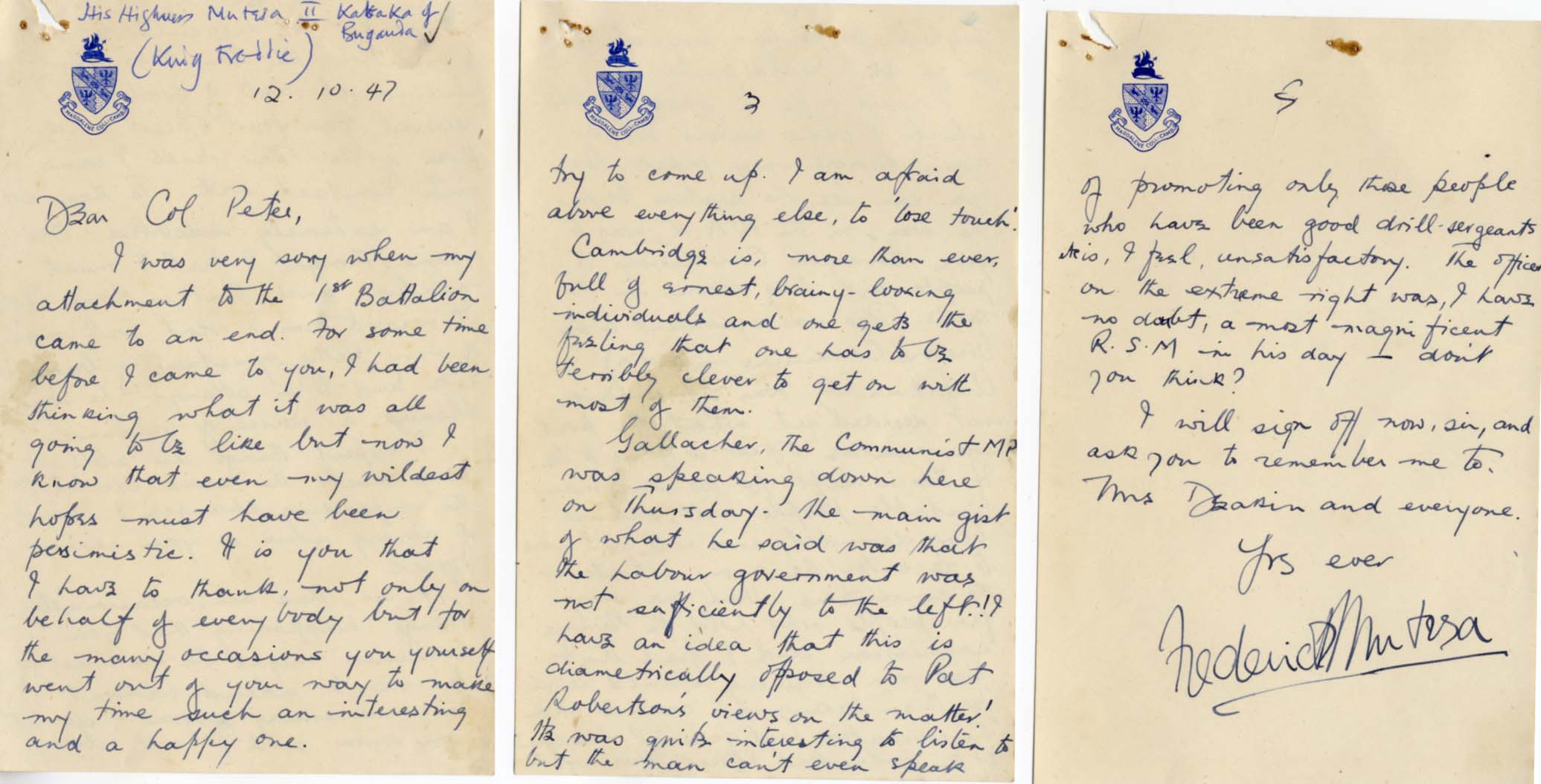
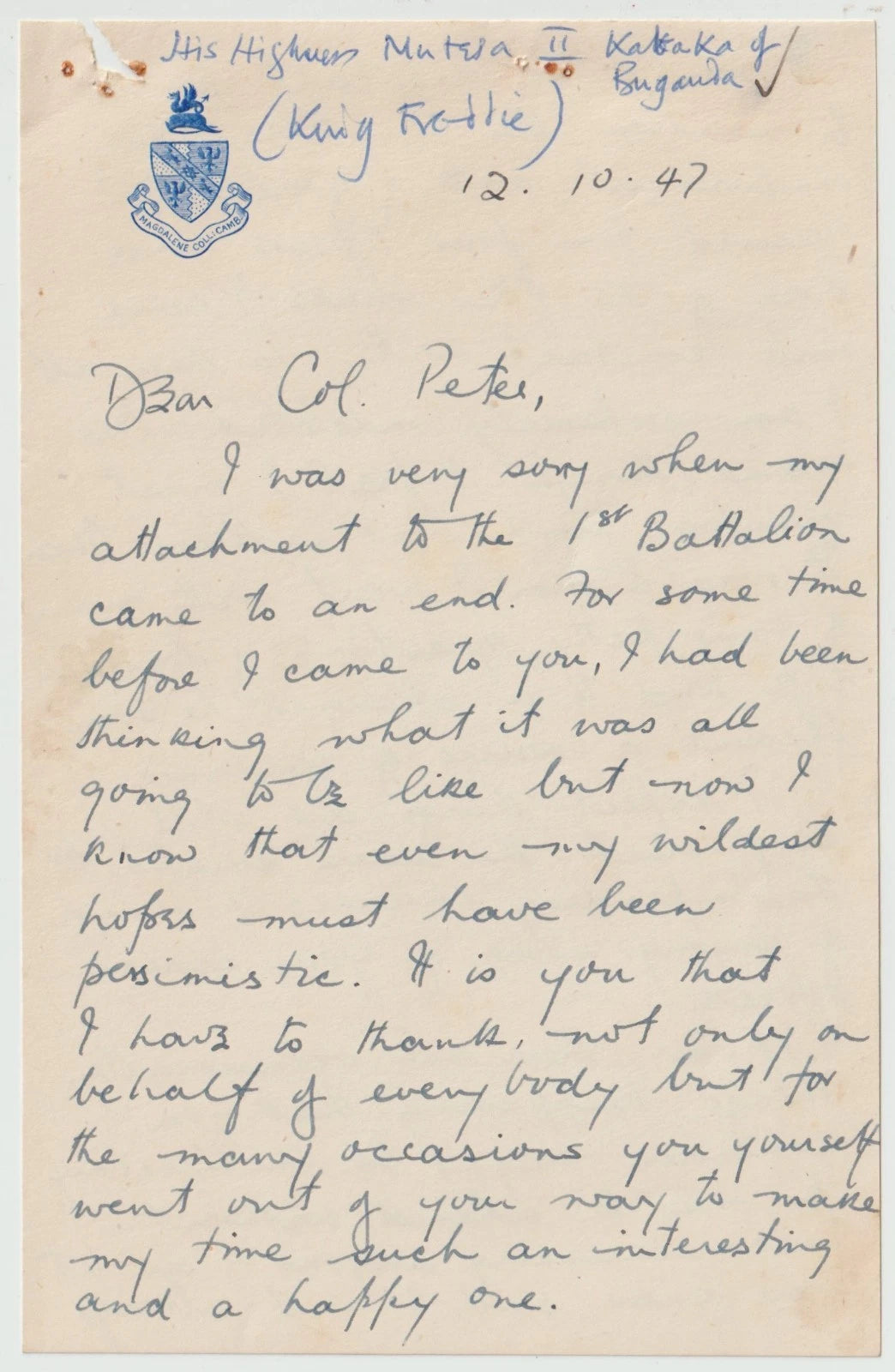
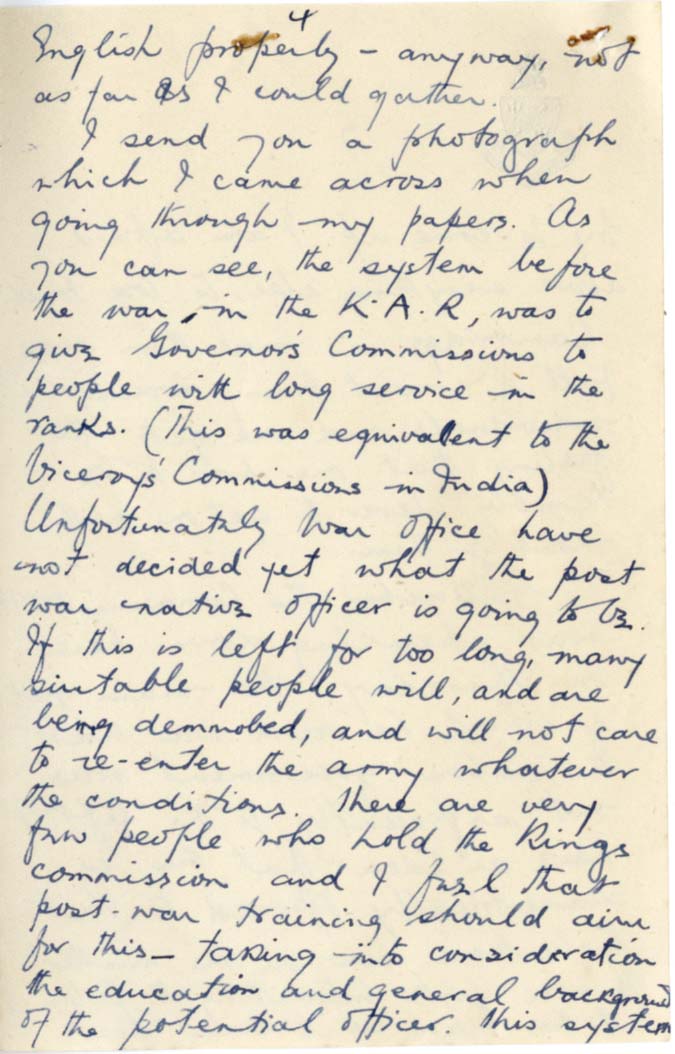
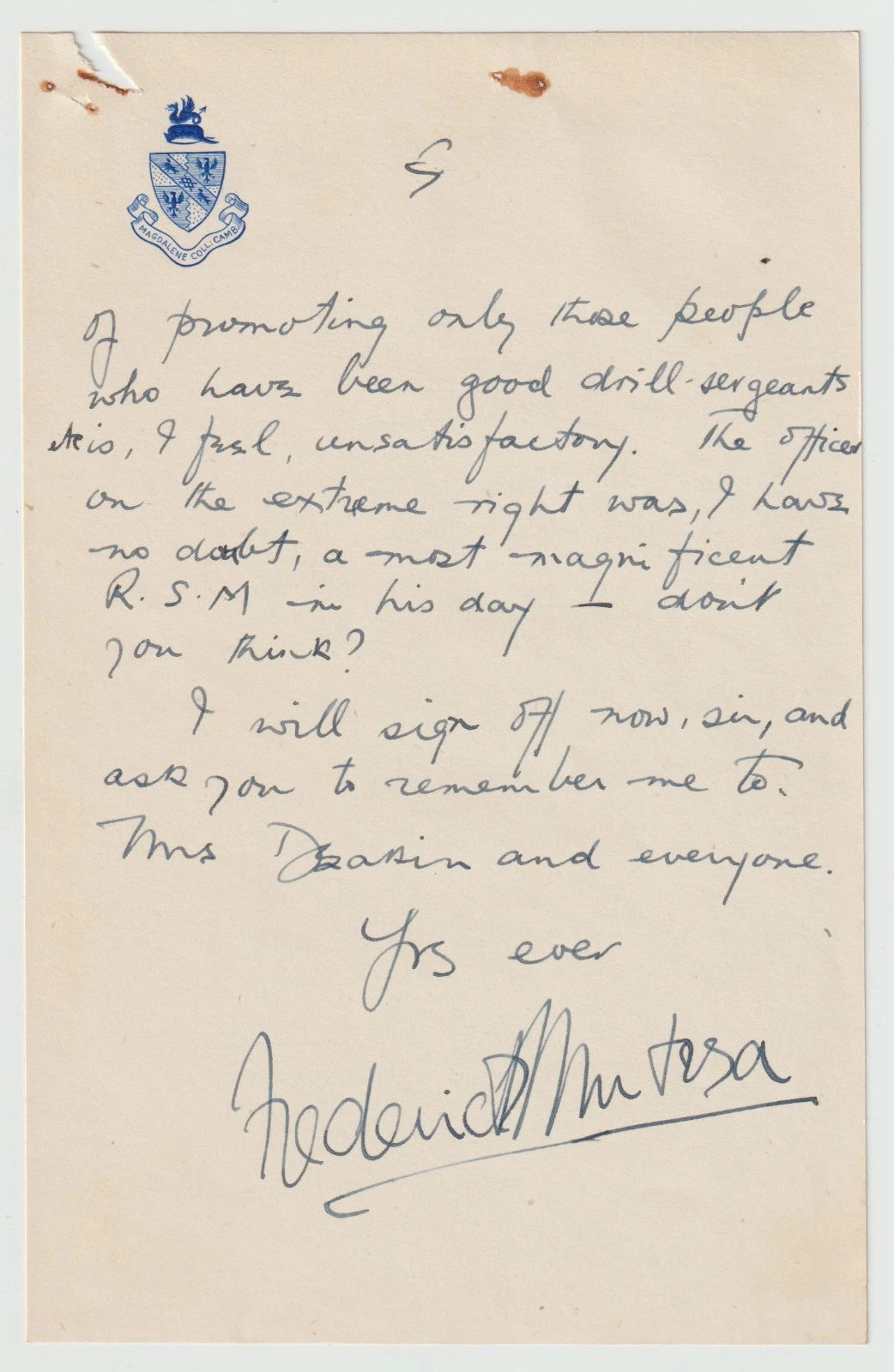
Eigenhändiger Brief mit Unterschrift, fünf Seiten - auf drei Blättern, 4,5 x 7 inch, `Magdalene College - Cambridge` Briefkopf, in englischer Sprache, an "Colonel Peter" - u. a. politische und militärische Angelegenheiten betreffend, in dunkler Tinte geschrieben und signiert "Frederick Mutesa", mit Nadellöchern am oberen Rand und einem kleinen Einriss an der oberen linken Ecke von zwei Seiten - in gutem Zustand. Selten!
"Dear Colonel Peter,
I was very sorry when my attachment to the 1st Battalion came to an end. For some time before I came to you, I had been thinking what it was all going to be like but now I know that even my wildest hopes must have been pessimistic. It is you that I have to thank, not only on behalf of everybody, but for the many occasions you yourself went out of your way to make my time such an interesting and a happy one.
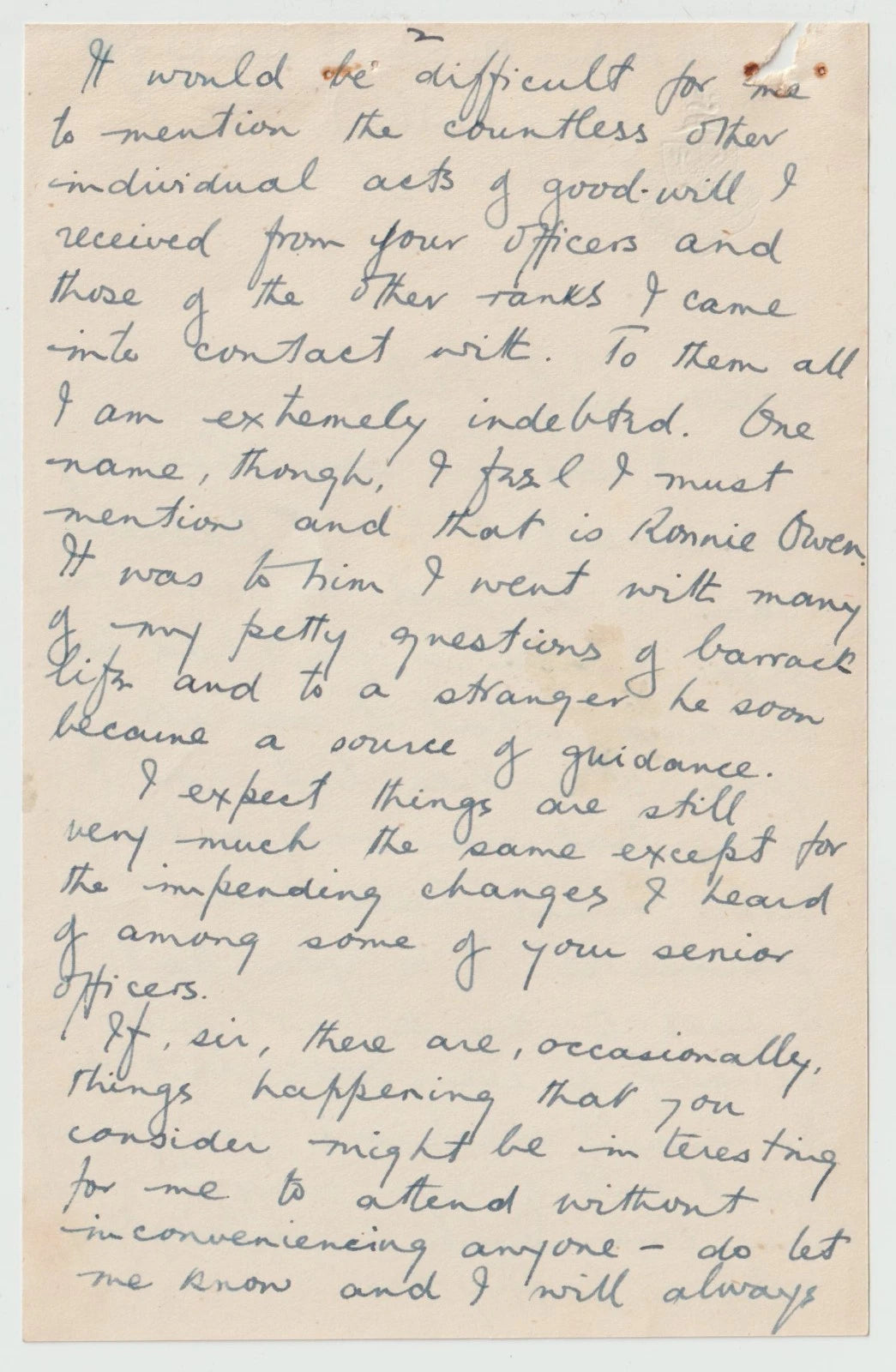
It would be difficult for me to mention the countless other individual acts of good will I received from your officers and those of the other ranks I came into contact with. To them all I am extremely indebted. One name, though, I feel I must mention and that is Ronnie Owen. It was to him I went with many of my petty questions of barrack life and to a stranger he soon became a source of guidance.
I expect things are still very much the same except for the impending changes I heard of among some of your senior officers.
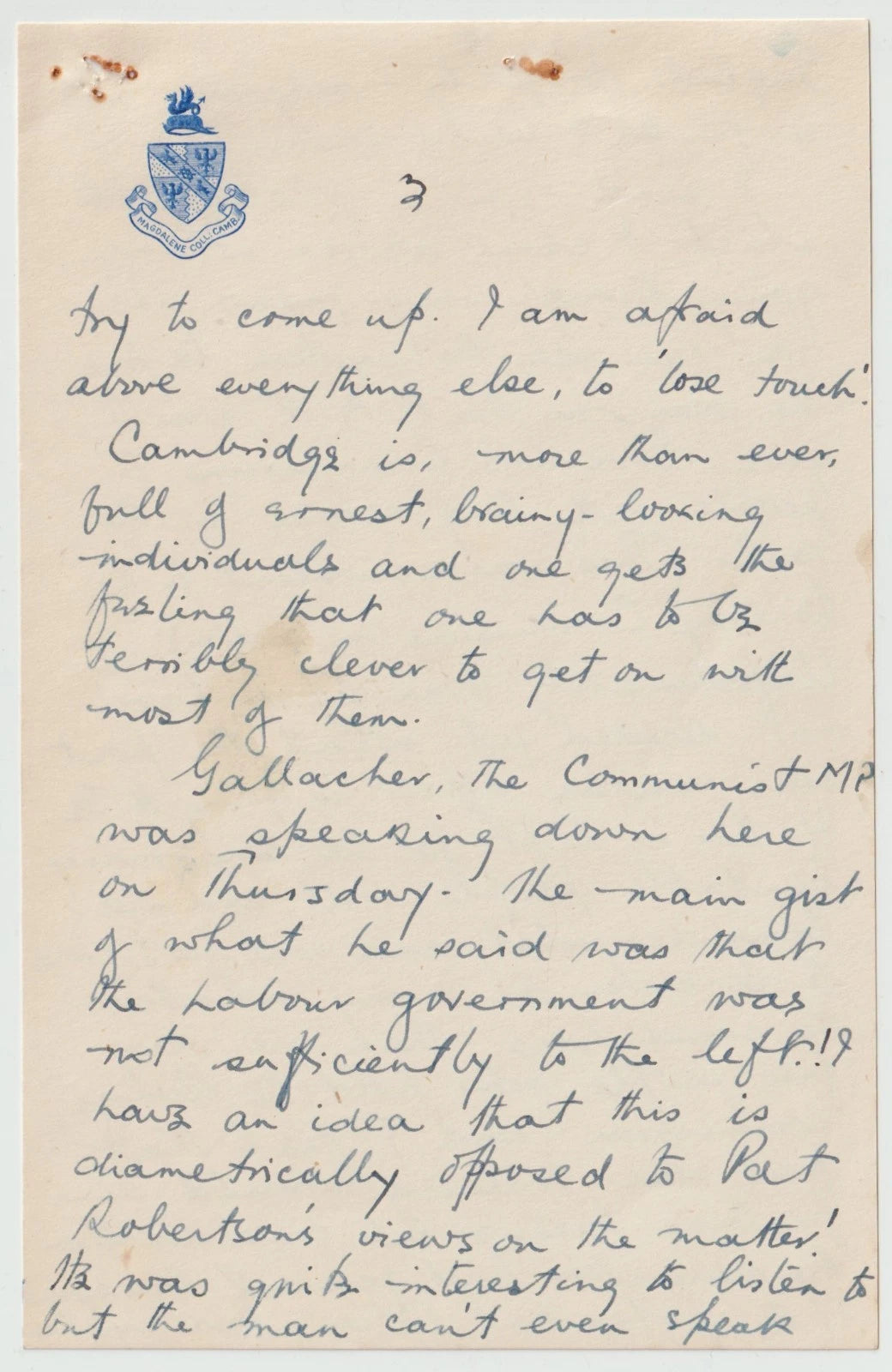
If, sir, there are, occasionally, things happening that you consider might be interesting for me to attend without inconveniencing anyone - do let me know and I will always try to come up. I am afraid above everything else to 'lose touch'. Cambridge is, more than ever, full of ernest brainy-looking individuals and one gets the feeling that one has to be terribly clever to get on with most of them.
Gallacher the communist MP was speaking down here on Thursday. The main gist of what he said was that the Labour government was not sufficiently to the left! I have an idea that this is diametrically opposed to Pat Robertson's views on the matter! He was quite interesting to listen to but the man can't even speak English properly - anyway, not as far as I could gather.
I send you a photograph which I came across while going through my papers. As you can see, the system before the war in the KAR was to give governor's commissions to people with long service in the ranks (this was equivalent to Viceroy's commissions in India). Unfortunately War Office have not decided yet what the postwar native officer is going to be. If this is left for too long, many suitable people will and are being demobbed, and will not care to re-enter the army whatever the conditions. There are very few people who hold the King's commission and I feel that postwar training should aim for this - taking into consideration the education and general background of the potential oficer. This system of promoting only those people who have been good drill-sergeants etc is, I feel, unsatisfactory. The officer on the extreme right was, I have no doubt, a most magnificent RSM in his day - don't you think?
I will sign off now sir, and ask you to remember me to Mrs Deakin and everyone.
Yours ever - Frederick Mutesa"
Weitere Infos zur Person
Profession:
(1924-1969) Ugandan royal and statesman who served as the first president of Uganda from 1962 to 1966, when he was overthrown by Milton Obote
Year of Birth: 1924
Mutesa II of Buganda, also known as Sir Edward Frederick Mutesa, was born on November 19, 1924, in Kampala, Uganda. He was a Ugandan politician and the kabaka (ruler) of the Kingdom of Buganda from 1939 until his death in 1966.
As a young man, Mutesa II was educated at King's College Budo, a prestigious school in Uganda. He later attended Makerere University, where he studied law and politics, before ascending to the throne as kabaka of Buganda at the age of 15.
During his reign, Mutesa II worked to modernize Buganda and improve the lives of its people. He was known for his intelligence, vision, and diplomatic skills, which helped him navigate the complex political landscape of Uganda during a time of great change.
In 1962, Uganda gained independence from British colonial rule, and Mutesa II became the first president of the newly formed country. However, his tenure was short-lived as he was overthrown in a military coup in 1966 by General Idi Amin, who accused him of collaborating with the country's enemies.
After being overthrown, Mutesa II went into exile in the United Kingdom, where he continued to advocate for the rights of the Buganda people and the restoration of his monarchy. He passed away on November 21, 1969, at the age of 45.
Despite his tumultuous reign and untimely death, Mutesa II is remembered as a progressive and visionary leader who sought to modernize Buganda and improve the lives of its people. His legacy continues to inspire the people of Uganda and beyond.
Echtheitszertifikat
Zahlung & Sicherheit
Deine Zahlungsinformationen werden sicher verarbeitet. Wir speichern keine Kreditkartendaten und haben auch keinen Zugang zu deinen Kreditkartendaten.