
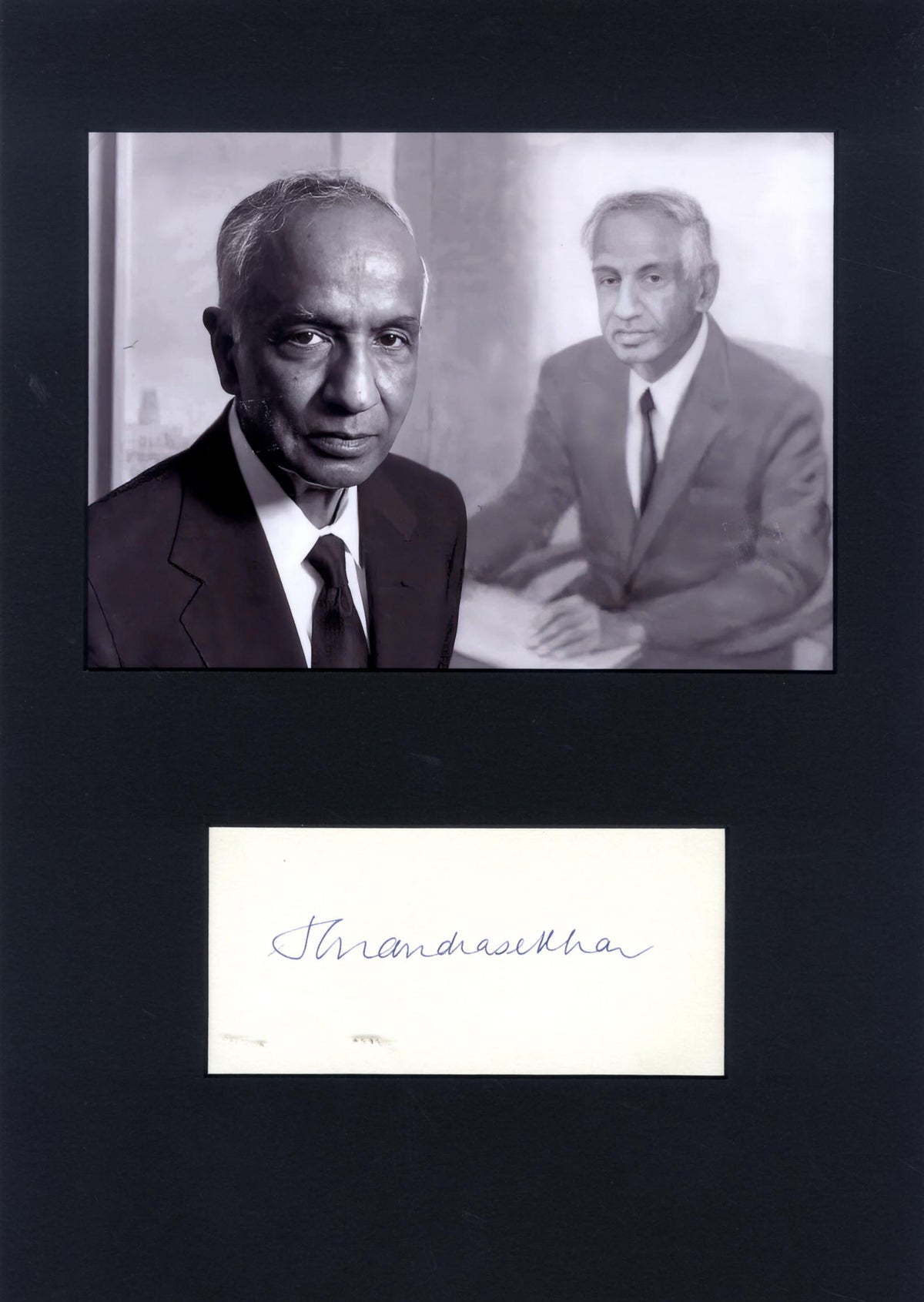

Descripción
Más información sobre la persona
Profession:
(1910-1995) Indian-American astrophysicist Nobel Prize in Physics (1983).
Year of Birth: 1910
Subrahmanyan Chandrasekhar was born on October 19, 1910, in Lahore, Punjab, British India. He was an Indian-American astrophysicist who won the Nobel Prize in Physics in 1983 for his work on the structure and evolution of stars. He was also the first astrophysicist to be awarded the Nobel Prize.
Chandrasekhar was the youngest son of an Indian civil servant and was educated at the University of Madras and Cambridge University. He studied mathematics, physics, and astronomy at both universities, and was particularly interested in stellar structure and evolution. He was also a member of the Royal Astronomical Society and was one of the founding members of the Indian Institute of Science.
In 1937, Chandrasekhar published his most famous work, An Introduction to the Study of Stellar Structure. In this book, he provided a mathematical description of the structure and evolution of stars. He also proposed that stars with a mass greater than 1.4 solar masses, known as the Chandrasekhar limit, would eventually collapse into a compact object, such as a black hole. This work was the basis for his Nobel Prize in 1983.
Chandrasekhar was also a professor at the University of Chicago, where he served as the Morton D. Hull Distinguished Service Professor of Astrophysics. He was also a visiting professor at a number of other institutions, including Harvard University, the University of Cambridge, and the University of Oxford. He was a member of the National Academy of Sciences and the American Philosophical Society.
In addition to his work on stellar structure and evolution, Chandrasekhar also made significant contributions to the fields of hydrodynamics and mathematics. He also wrote extensively on the history of astronomy, including his book, History of Astronomy from 1920 to 1950. He was also the author of many monographs and books, including Principles of Stellar Dynamics.
Chandrasekhar was a respected teacher and mentor throughout his life and received many honors and awards, including the National Medal of Science, the Rumford Prize, and the Bower Award. He passed away in 1995 at the age of 84. He was widely regarded as one of the most influential astrophysicists of the 20th century, and his work continues to be referenced and studied by astronomers and astrophysicists today.
Certificado de autenticidad
Todas nuestras piezas se venden con un certificado de autenticidad. Si una pieza resulta estar equivocada o si no le gusta un autógrafo, recuperará su dinero durante toda la vida.
Pago y seguridad
Su información de pago se procesa de forma segura. No almacenamos los detalles de la tarjeta de crédito ni tenemos acceso a la información de su tarjeta de crédito.