




Descripción
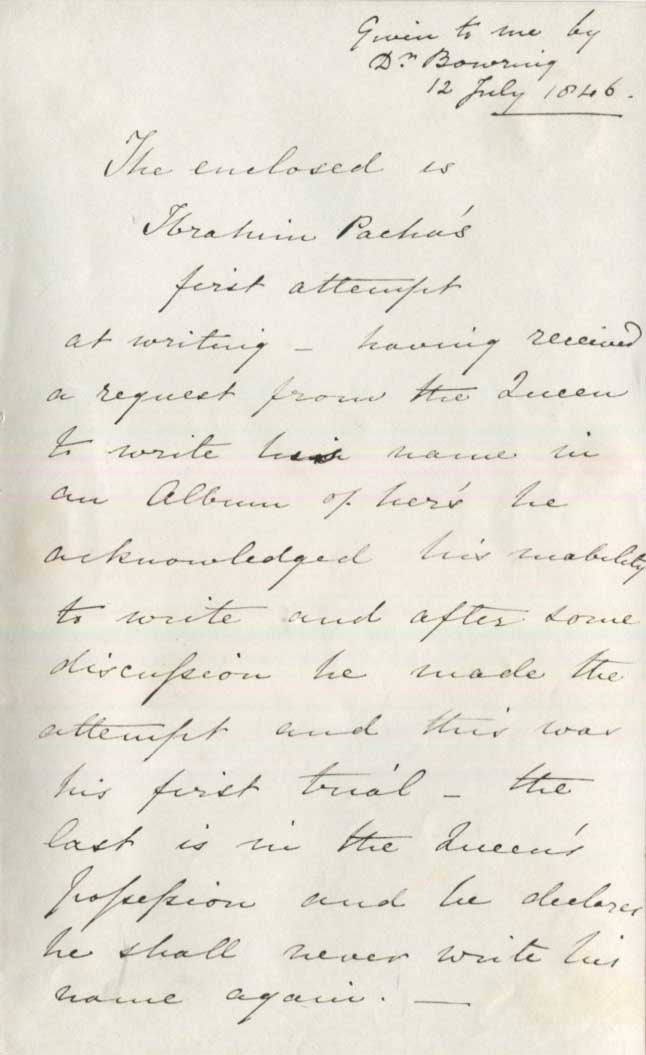
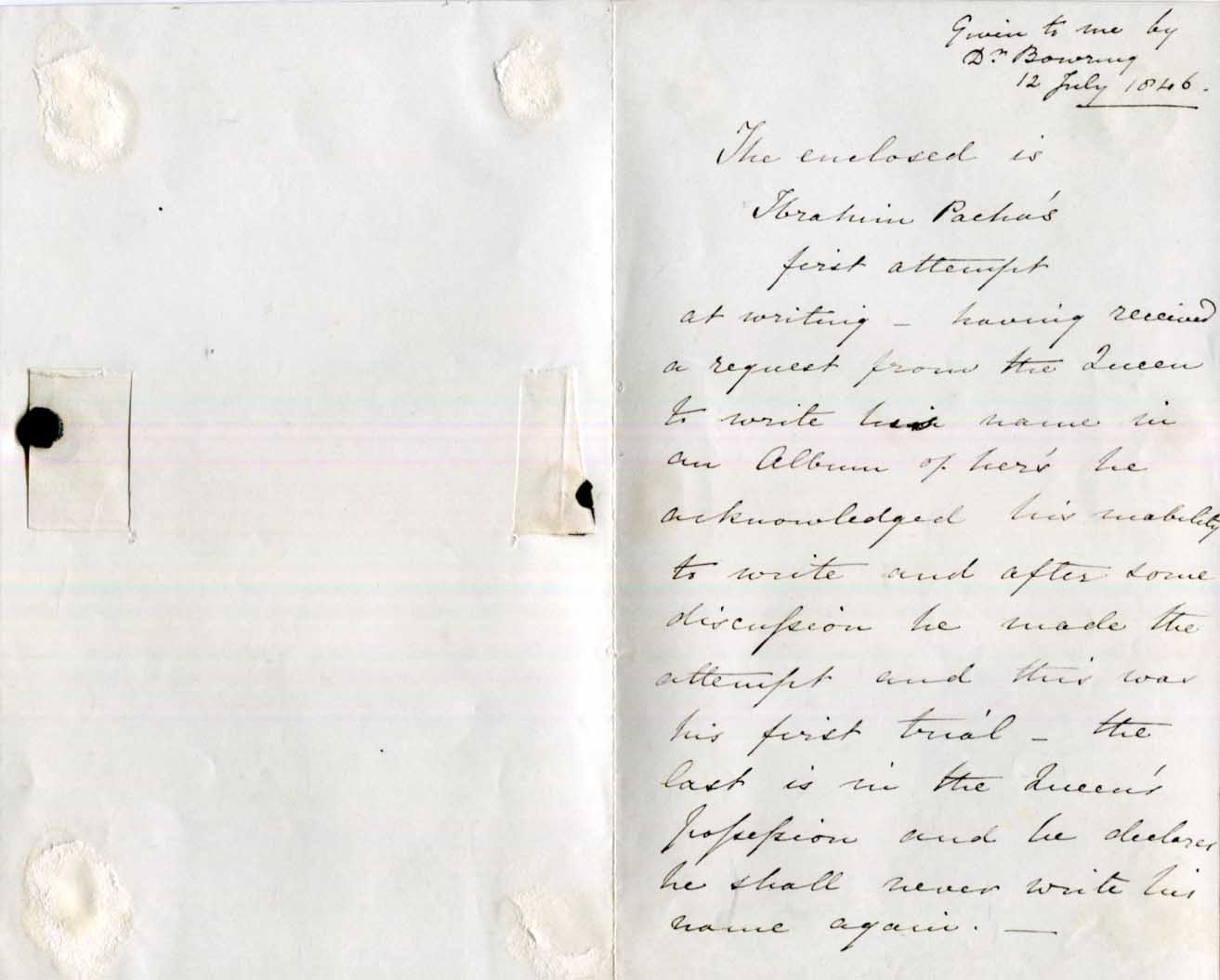
Letter with signed clipping, 4 x 1 inch - affixed to the integral blank leaf of a letter* (in English - concerning the signature) - 4,5 x 7 inch, (12.07.1846), signed in black ink, attractively mounted (removable) for fine display with a picture, shows Ibrahim Pasha of Egypt in a full length pose in uniform (altogether 8,25 x 11,75 inch), with trimmed edges and scattered mild signs of wear to the letter - in fine to very fine condition. Very rare!
* Letter:
"The enclosed is Ibrahim Pasha`s first attempt
at writing - having received a request from the Queen to write his name in an album of her`s he acknowledged his inability to write and after some discussion he made the attempt and this was his first trial - the last is in the Queen`s possession and he declared he shall never write his name again. -"
Más información sobre la persona
Profession:
(1789-1848) Egyptian general and politician; he was the commander of both the Egyptian and Ottoman armies and the eldest son of Muhammad Ali, the Ottoman Wāli and unrecognized Khedive of Egypt and Sudan.
Year of Birth: 1789
Ibrahim Pasha was a prominent military and political leader in the Ottoman Empire during the early 19th century. Born in 1789, he was the second son of Sultan Mahmud II and served as the governor of Egypt from 1848 to 1849.
Known for his strong leadership and military skills, Ibrahim Pasha played a key role in modernizing the Egyptian military and implementing reforms in the region. He was also instrumental in expanding the empire's territories through successful military campaigns.
Despite his military successes, Ibrahim Pasha faced opposition from various factions within the empire, including the European powers. His ambitious plans to establish an independent Egyptian state ultimately failed, leading to his exile in 1849.
Throughout his career, Ibrahim Pasha was known for his commitment to modernization and progress. He implemented various reforms in Egypt, including the construction of new infrastructure, the establishment of schools, and the promotion of industry and agriculture.
After his exile, Ibrahim Pasha settled in Istanbul, where he continued to play a role in the empire's affairs. He died in 1848, leaving behind a legacy of military prowess and reformist ideas that continue to influence the region to this day.
Overall, Ibrahim Pasha's career was marked by his dedication to strengthening the Ottoman Empire and advancing its interests in the face of both internal and external challenges.
Certificado de autenticidad
Todas nuestras piezas se venden con un certificado de autenticidad. Si una pieza resulta estar equivocada o si no le gusta un autógrafo, recuperará su dinero durante toda la vida.
Pago y seguridad
Su información de pago se procesa de forma segura. No almacenamos los detalles de la tarjeta de crédito ni tenemos acceso a la información de su tarjeta de crédito.