Descripción
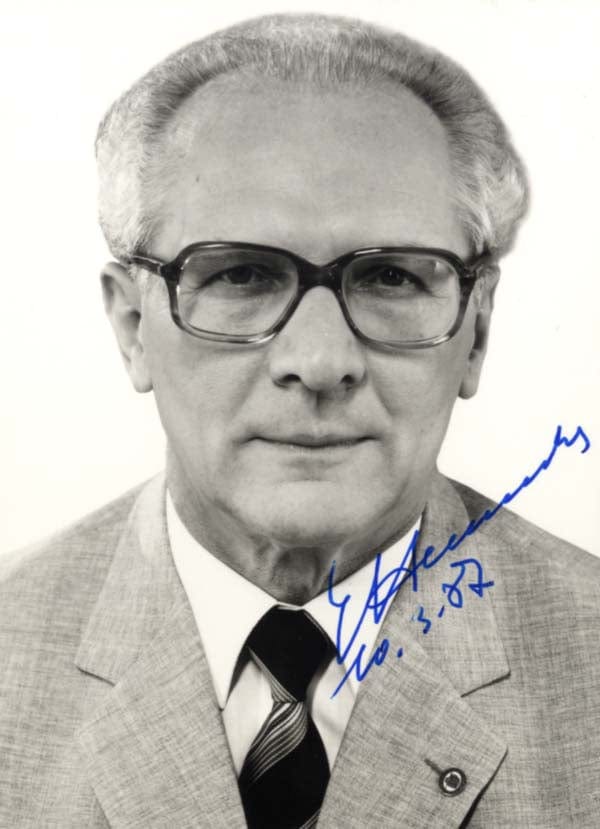
Signed vintage photograph, shows Erich Honecker in a chest-up portrait, 4 x 5,75 inch, signed and dated in blue ink "E. Honecker - 10.3.87", with mild creases to the upper right corner - in nearly very fine condition. Accompanied by photographs signed by Hans Modrow, Lothar de Maiziere, and Markus Wolf, all about 4 x 5,75 inch & a card signed by Egon Krenz, 5 x 3 inch.
Más información sobre la persona
Profession:
(1912-1994) East German communist politician who led the German Democratic Republic (East Germany) from 1971 until shortly before the fall of the Berlin Wall in October 1989.
Year of Birth: 1912
Erich Honecker was one of the most important figures in East German politics for over twenty years. He was born in 1912 in East Prussia and grew up in a working-class family. He joined the German Communist Party (KPD) in 1929 and became a full-time party official in 1933. During World War II, he was a political prisoner in Nazi Germany and was released from prison in 1945. After the war, Honecker was one of the founding members of the Socialist Unity Party (SED) and became a leader of the East German state. He was a key figure in the construction of the Berlin Wall and in the creation of the East German economy. He was also the leader of the East German delegation to the Warsaw Pact and actively supported the Soviet Union's foreign policies. Honecker was forced to resign in 1989 when it became clear that East Germany was about to undergo major political and economic changes. He died in 1994.
Horst Sindermann was a leading East German politician who played a major role in the post-war reconstruction of East Germany. He was born in 1919 in East Prussia and joined the Communist Party in 1935. During World War II, he was a political prisoner in the Soviet Union and was released in 1945. After the war, Sindermann was one of the founding members of the Socialist Unity Party (SED) and a leader of the East German state. He was a strong supporter of the Soviet Union and its foreign policies, and he was also a key figure in the construction of the Berlin Wall. Sindermann was forced to resign from his post as East German Prime Minister in 1989 when it became clear that East Germany was about to undergo major changes. He died in 1994.
Hans Modrow was another key figure in East German politics. He was born in 1928 in East Prussia and joined the Communist Party in 1945. After the war, he was one of the founding members of the Socialist Unity Party (SED) and was elected to the East German parliament in 1950. He was a strong supporter of the Soviet Union and its foreign policies and actively participated in the construction of the Berlin Wall. Modrow was appointed as East German Prime Minister in 1989 and implemented a series of reforms in an attempt to keep East Germany from collapsing. He was forced to resign in 1990 when it became clear that East Germany was about to reunify with West Germany. He later served as a member of the Bundestag, the German national parliament.
Other important East German politicians included Erich Mielke, the head of the East German secret police, and Willi Stoph, the East German Prime Minister from 1964 to 1989. Both of these men were strong supporters of the Soviet Union and its foreign policies and actively participated in the construction of the Berlin Wall. In addition, Erich Mielke was responsible for the suppression of political dissidents in East Germany and for the Stasi secret police. He was forced to resign in 1989 and was later convicted of murder.
The fall of East Germany in 1989 was due in large part to the efforts of the East German people, who had grown increasingly dissatisfied with the repressive regime. This dissatisfaction was expressed in the form of peaceful protests and demonstrations, which eventually forced the East German government to accept the reunification of East and West Germany. In the aftermath of the reunification, many of the former East German politicians, such as Erich Honecker, Horst Sindermann, and Hans Modrow, were tried and convicted of various crimes, such as corruption and abuse of power.
Today, many of the former East German politicians have been pardoned or released from prison. While some have returned to politics, others have chosen to pursue other interests. Regardless of their current occupations, however, all of these men played an important role in the history of East Germany and helped shape its future.
Certificado de autenticidad
Todas nuestras piezas se venden con un certificado de autenticidad. Si una pieza resulta estar equivocada o si no le gusta un autógrafo, recuperará su dinero durante toda la vida.
Pago y seguridad
Su información de pago se procesa de forma segura. No almacenamos los detalles de la tarjeta de crédito ni tenemos acceso a la información de su tarjeta de crédito.


