

Beschreibung
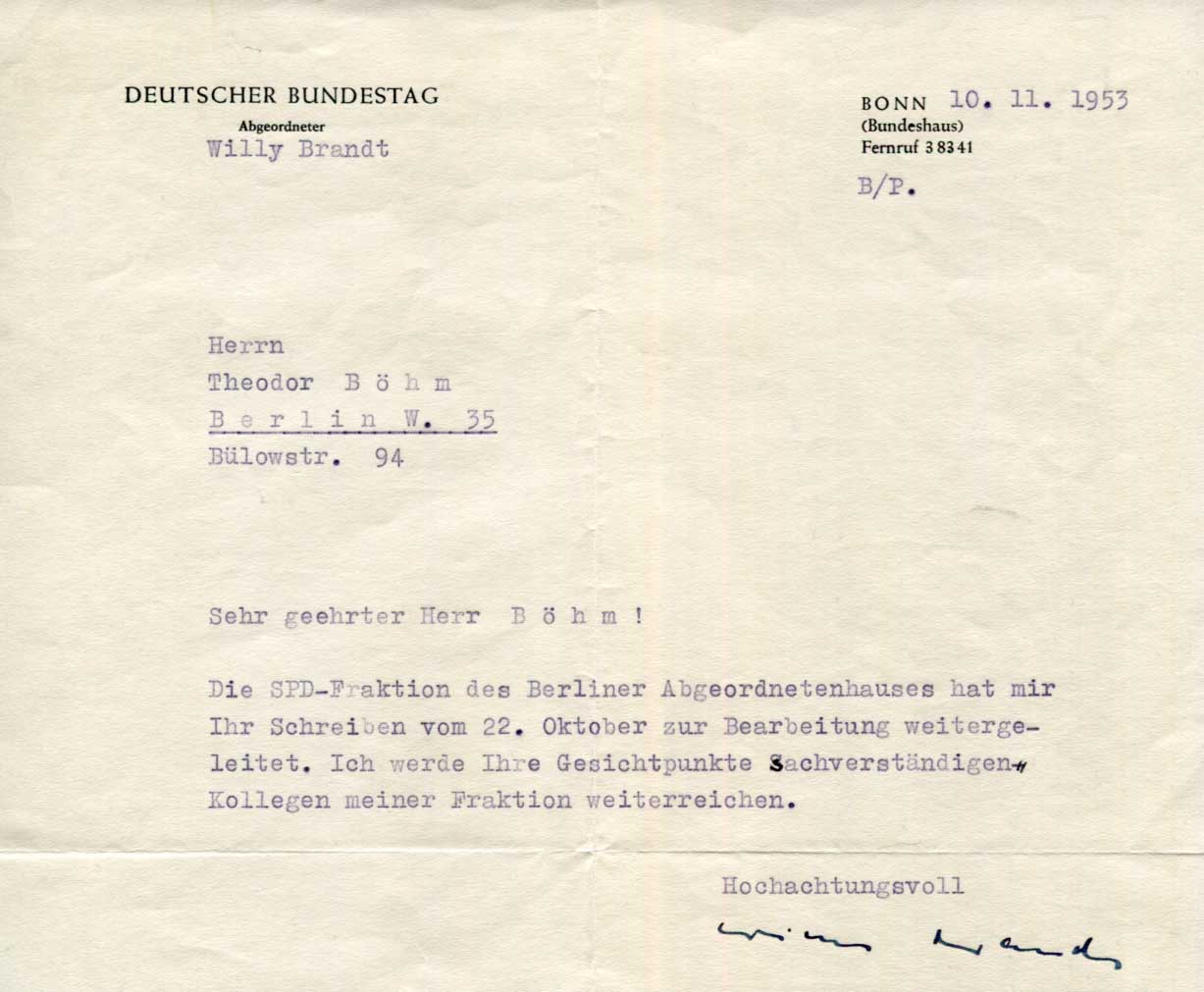
Maschinengeschriebener Brief mit eigenhändiger Unterschrift, eine Seite, 8,25 x 6,75 inch, Bonn, 10.11.1953, `Deutscher Bundestag` Briefbogen, Antwortschreiben an Theodor Böhm, signiert in dunkler Tinte "Willy Brandt", mit leichten Gebrauchsspuren - in gutem bis sehr gutem Zustand.
"Sehr geehrter Herr Böhm!
Die SPD-Fraktion des Berliner Abgeordnetenhauses hat mir Ihr Schreiben vom 22. Oktober zur Bearbeitung weitergeleitet. Ich werde Ihre Gesichtspunkte sachverständigen Kollegen meiner Fraktion weiterreichen."
Weitere Infos zur Person
Profession:
(1913 - 1992) Deutscher Staatsmann, Bundeskanzler der Bundesrepublik Westdeutschland von 1969 bis 1974
Year of Birth: 1913
Willy Brandt was a German statesman who served as Chancellor of West Germany from 1969 to 1974. He was the first Social Democrat to be elected Chancellor since the foundation of the German Empire in 1871. Brandt was born in Lübeck, Germany, on December 18, 1913. His father, Johann Brandt, was a ship's captain and merchant, and his mother, Martha Frahm, was a seamstress. Brandt grew up in an environment of political and social turmoil due to the First World War, the Great Depression and the rise of the Nazi Party in Germany.
Brandt attended school until the age of 14, when he left to become a merchant sailor. He was politically active during his time at sea, joining the Social Democratic Party in 1931. In 1933, he was forced to flee Germany due to the Nazi regime's suppression of political opponents. He eventually settled in Norway, where he worked as a journalist and became active in the Norwegian Labour Party.
In 1940, Brandt was arrested by the Nazis and imprisoned in a concentration camp. He was released in 1941 and managed to escape to Sweden, where he continued to work as a journalist. In 1945, Brandt returned to Germany and was elected to the Bundestag, the lower house of the German Parliament. He quickly rose to prominence in the Social Democratic Party, becoming its leader in 1964.
Brandt was a strong advocate for German reunification and European cooperation. He was instrumental in the signing of the Ostpolitik treaties, which normalized relations between East and West Germany and paved the way for German reunification in 1990. He was awarded the Nobel Peace Prize in 1971 for his efforts at improving East-West relations.
Brandt's chancellorship was marked by a period of economic stability and political reform. He implemented a series of social welfare and economic reforms, including increased government spending on education and health care. He also sought to improve relations with other countries, particularly in the East, and made visits to China, the Soviet Union, and other nations.
Brandt resigned as Chancellor in 1974 following a financial scandal. He continued to be active in German politics until his death in 1992. He is remembered as one of the most influential German leaders of the twentieth century and a champion of European unity.
Echtheitszertifikat
Zahlung & Sicherheit
Deine Zahlungsinformationen werden sicher verarbeitet. Wir speichern keine Kreditkartendaten und haben auch keinen Zugang zu deinen Kreditkartendaten.