


Description
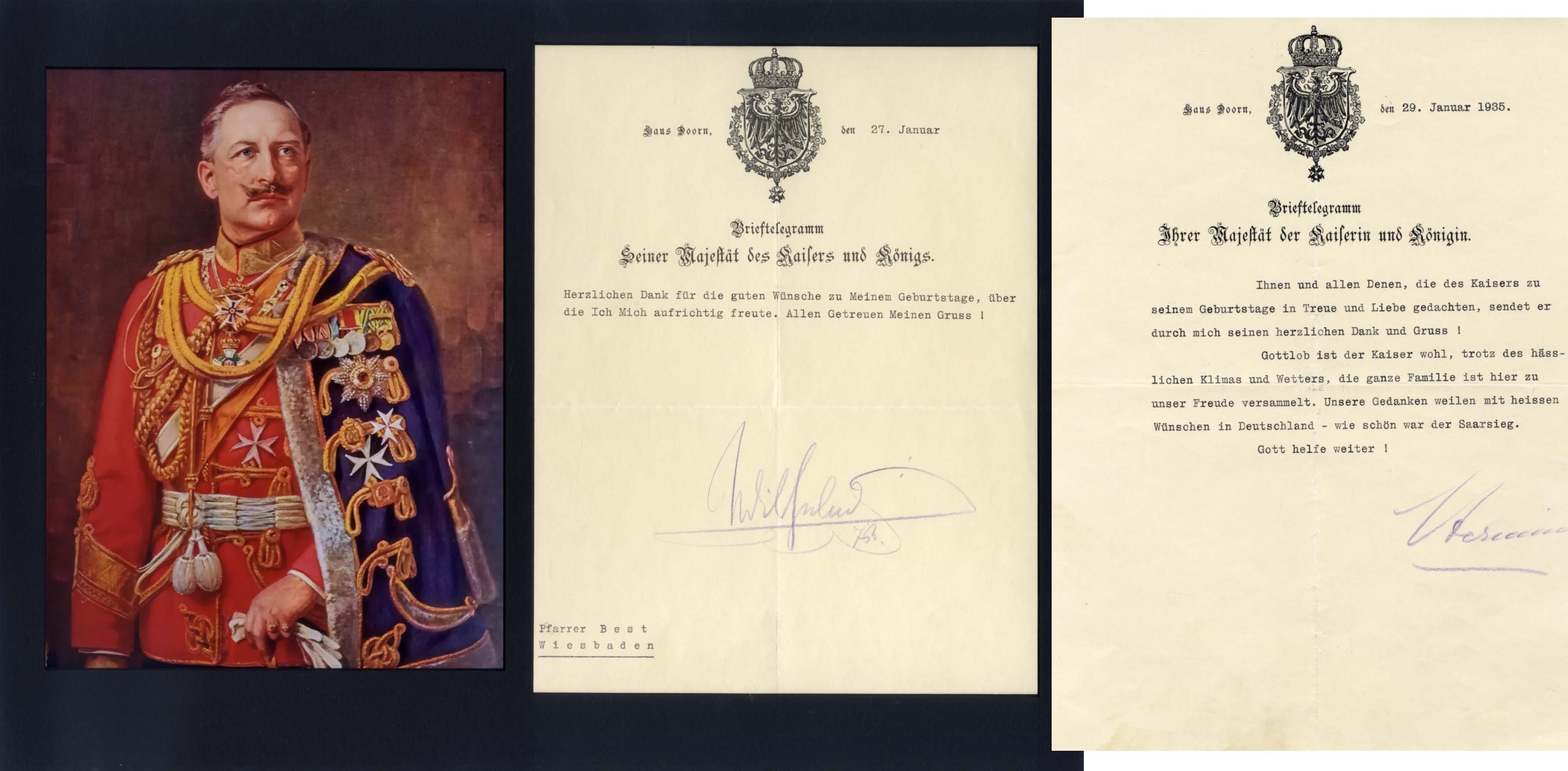
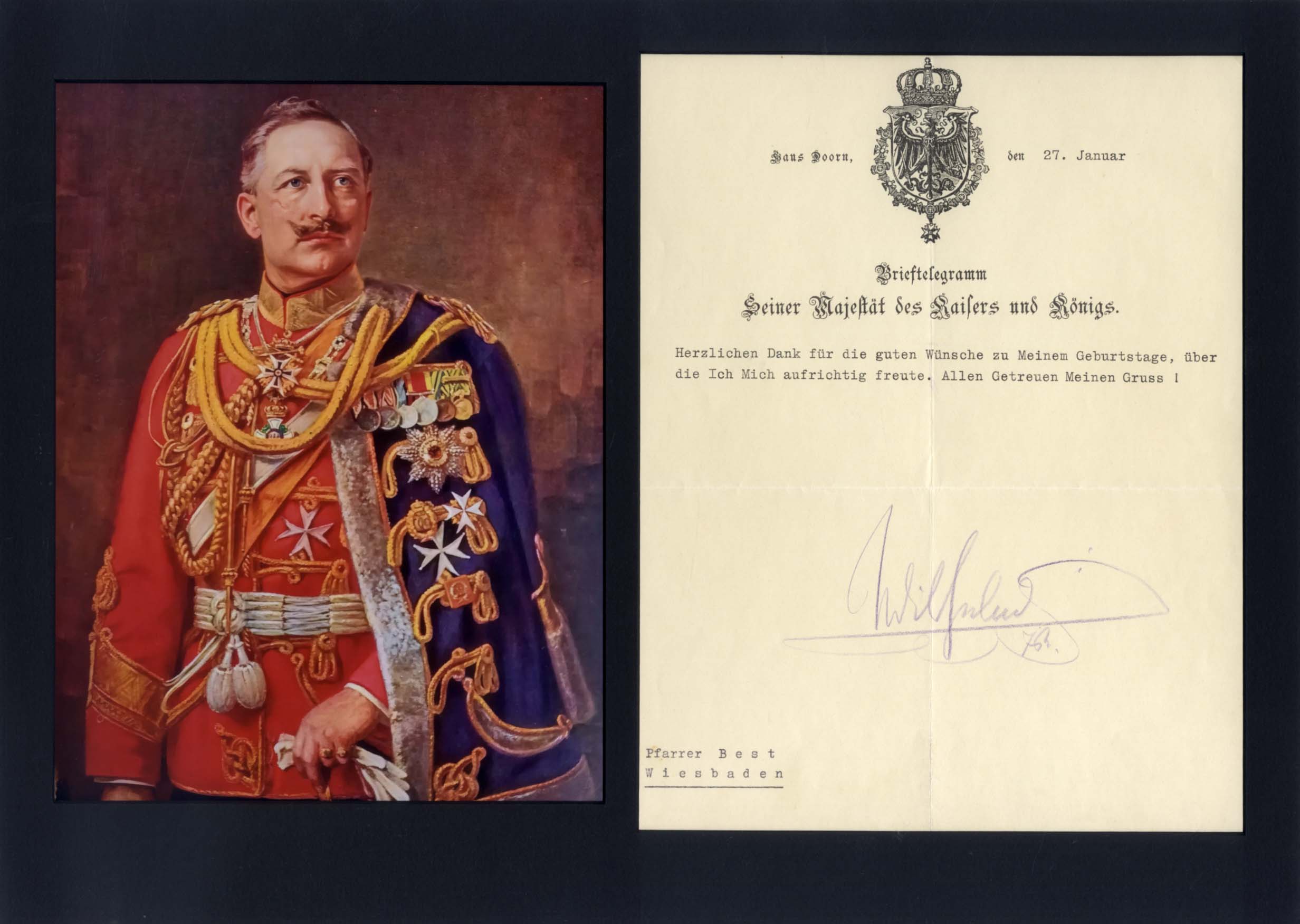
Typed letter signed, one page, 8 x 10,5 inch, personal stationery, Haus Doorn, 27.01.1935, in German, to Pastor Best in Wiesbaden - thanking for birthday wishes, signed in blue pencil "Wilhelm I.R.", attractively mounted (removable) for fine display with a picture, shows Wilhelm II in a beautiful half length portrait in uniform (altogether 16,5 x 11,75 inch), with very mild signs of wear - in nearly very fine condition. Accompanied by a typed letter signed by Hermine Reuss of Greiz, one page, 8,25 x 11 inch, personal stationery, Haus Doorn, 29.01.1935, in German, to an unnamed correspondent - thanking for birthday wishes to the Emperor, signed in blue pencil "Hermine", with very mild signs of age wear - in nearly very fine condition.
"Herzlichen Dank für die guten Wünsche zu Meinem Geburtstage, über die Ich mich aufrichtig freute. Allen Getreuen Meinen Gruss !"
Translated:
"Many thanks for the kind wishes on my birthday, which I truly appreciated. Greetings to all my faithful followers!"
Further Information on the person
Profession:
(1859-1941, Wilhelm II) last German Emperor (German: Kaiser) and King of Prussia, reigning from 15 June 1888 until his abdication on 9 November 1918 & (1887-1947, Hermine) Second wife of Wilhelm II.
Year of Birth: 1859
Wilhelm II, also known as Kaiser Wilhelm II, was the last German Emperor and King of Prussia. He was born on January 27, 1859, in Potsdam, Germany, as the eldest grandchild of Queen Victoria and Prince Albert of Britain.
Wilhelm II ascended to the throne in 1888 after the death of his father, Emperor Frederick III. He ruled Germany during a time of great political and social upheaval, leading up to World War I.
Known for his ambitious and aggressive foreign policies, Wilhelm II played a significant role in the events that led to the outbreak of World War I in 1914. He was seen as a militaristic leader, aiming to expand Germany's influence and control in Europe.
During his reign, Wilhelm II clashed with other world leaders, particularly his cousin King George V of Britain and his uncle Tsar Nicholas II of Russia. His actions and decisions were often criticized by his contemporaries and historians alike.
After Germany's defeat in World War I, Wilhelm II abdicated the throne and went into exile in the Netherlands. He lived in relative obscurity for the rest of his life, passing away on June 4, 1941.
Wilhelm II's legacy remains controversial, with some viewing him as a misguided ruler who contributed to the downfall of Germany, while others see him as a victim of circumstances beyond his control.
Certificate of authenticity
All of our pieces are sold with a Certificate of Authenticity. If a piece turns out to be wrong or if you do not like an autograph, you will get your money back for a lifetime.
Payment & Security
Your payment information is processed securely. We do not store credit card details nor have access to your credit card information.