




Description
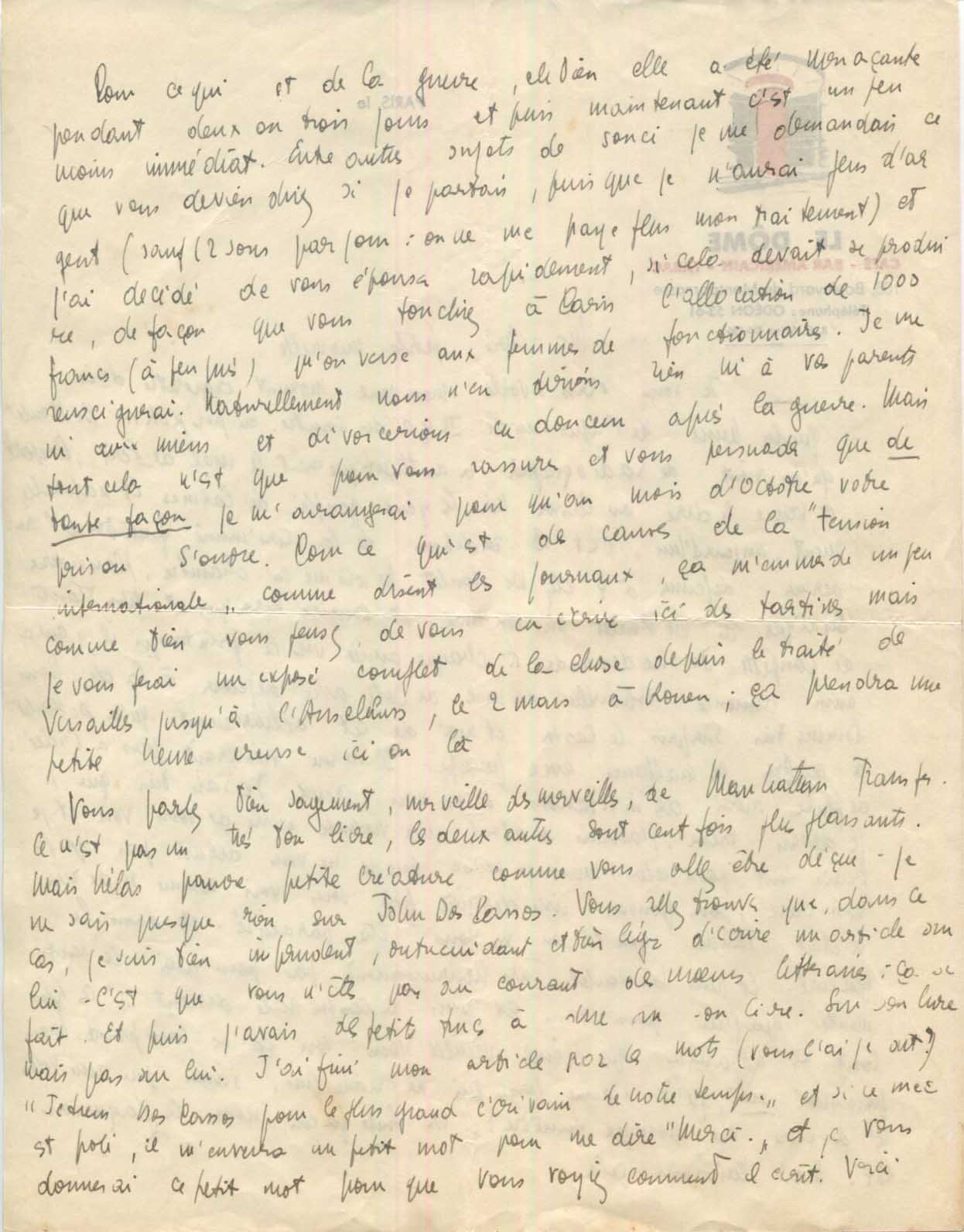
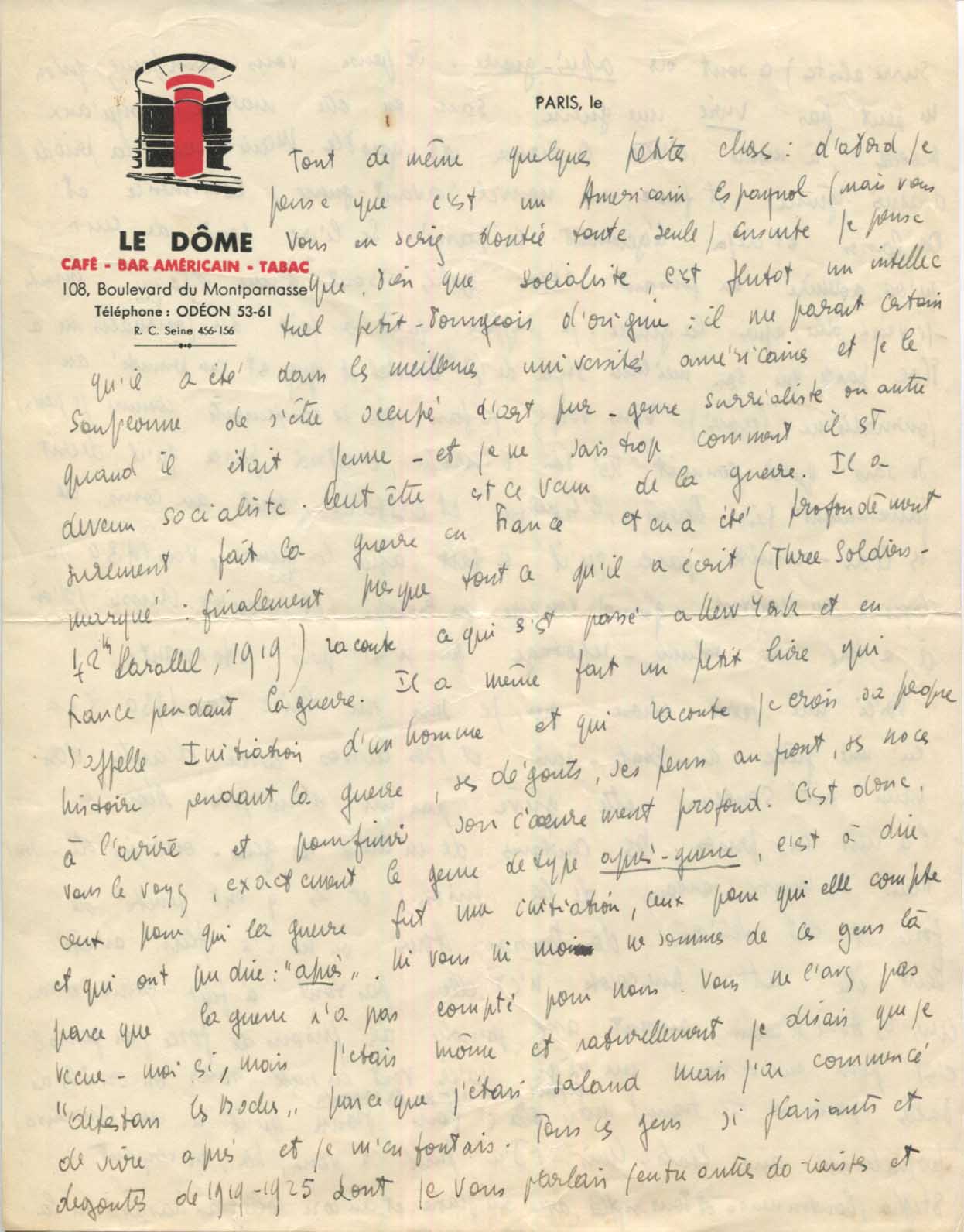
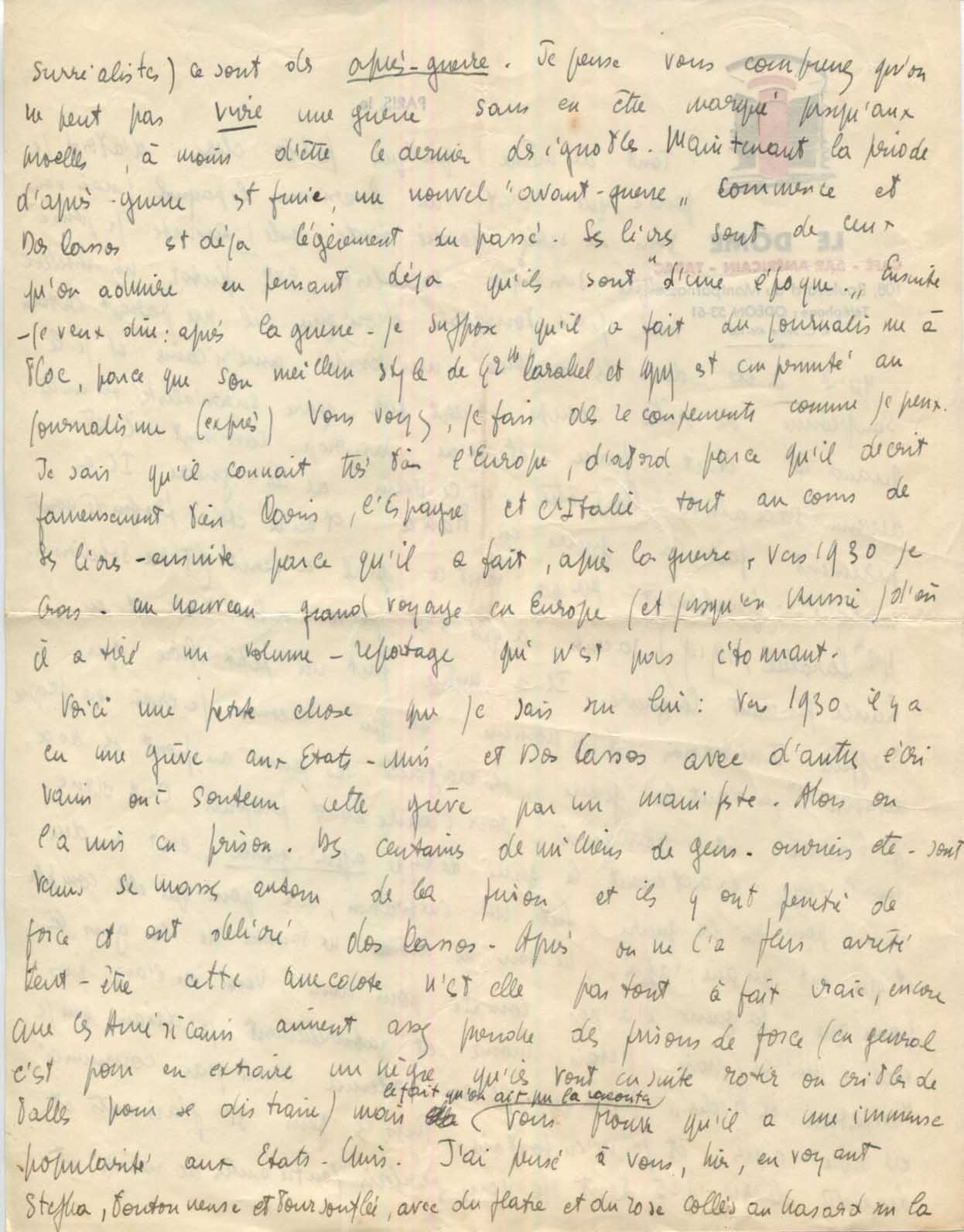
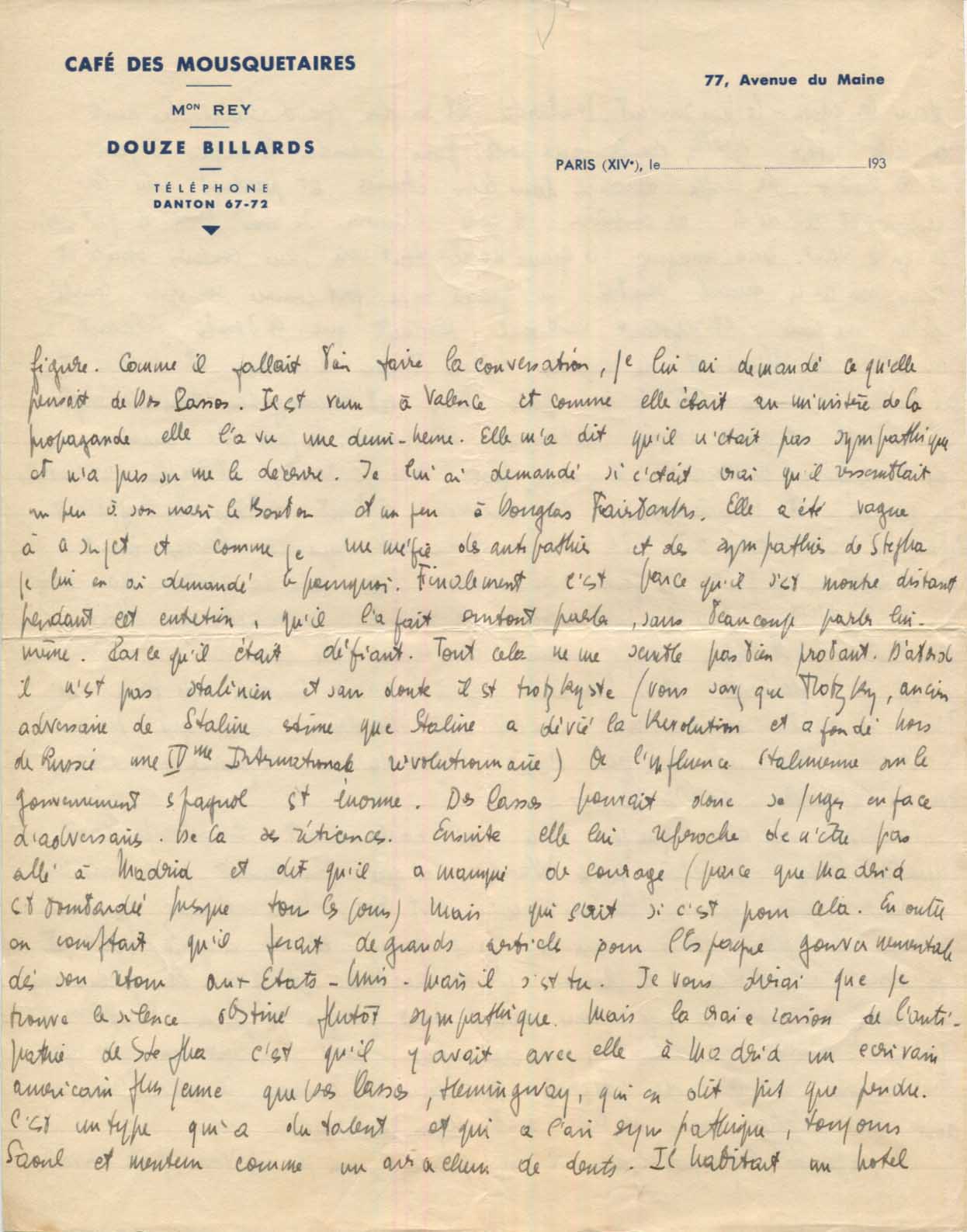
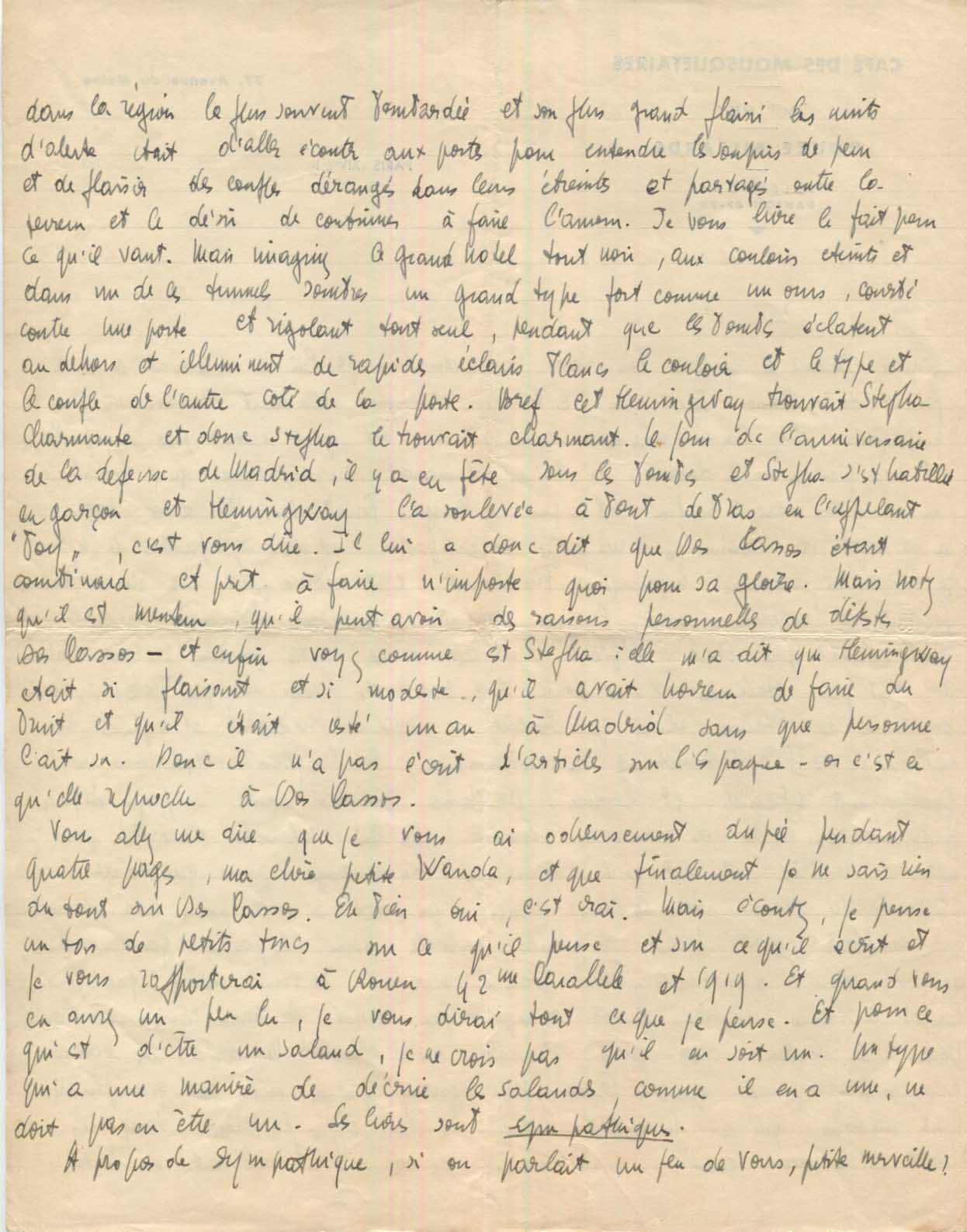
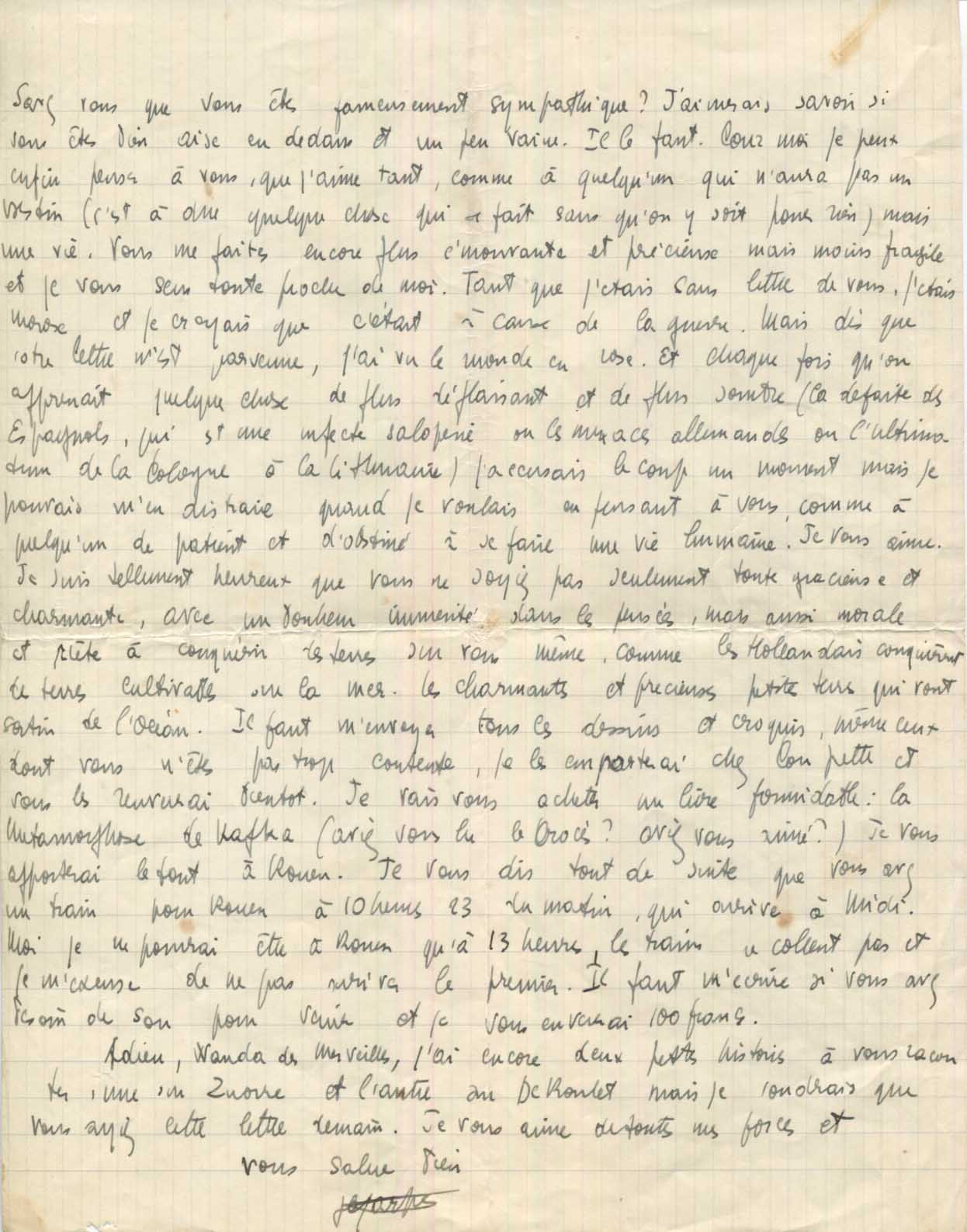
Exceptional autograph letter signed, 7 pages - on 4 sheets (both sides), 8,25 x 10,5 inch, (2x) `Dôme` (Brasserie in Montparnasse) & (1x) `Café des Musquetaires` stationery, (Paris), n.d. [March - August 1938], in French, very important and long pre-war letter to his lover „Ma chére petite merveille“ - Jean-Paul Sartre discusses the American Writer John Dos Passos at length [an article by Sartre on Dos Passos had been published in the NRF in February 1938], Hemingway, his friends Stepha, Lionel de Roulet (future husband of Helene de Beauvoir, Simone de Beauvoir`s younger sister) and Poupette, the `Anschluss` (Annexation of the Federal State of Austria into Nazi Germany on 12 March 1938), the German ultimatum to Lithuania, and his future marriage to Wanda, written and signed in dark ink "JP Sartre", with mild browning, intersecting letter folds, a few small stains, and mild signs of wear to the edges - in fine condition.
In parts:
"Ma chère petite Merveille
Je vous écris, voilà mon seul moment agréable d'ici quatre heures de l'après-midi. Il y a du sombre en perspective: De Roulet qu'on vient de radiographier a authentiquement le mal de Pott; Poupette [Hélène de Beauvoir] est venue le dire au Castor hier, les yeux gonflés de larmes [...]. Nous sommes bien surpris le Castor et moi de cet acharnement qu'a De Roulet à célébrer ces malheurs avec pompe. Il ne me viendrait pas à l'idée de faire ainsi des invitations à me voir crever. Je sais bien que si je devais crever, j'aurais d'abord une violente envie de vous voir et je ferais tout pour cela. Mais je pense que je ne vous dirais pas que je vais crever, pour pouvoir une dernière fois vous voir comme si de rien n'était. Tandis que là, on va tous être paralysé et dans le glacial [...]. Et puis le Castor râle disant: « Ces gens sont des apparences. Que Lionel veuille vous voir ça se comprend. Mais pourquoi moi, qu'il n'aime pas, qui ne l'aime pas, sinon par une volonté à vide de pompe funèbre ? ». De toute façon nous le plaquerons tôt. Mais laissons cela.
Pour ce qui est de la guerre, et bien elle a été menaçante pendant deux ou trois jours et puis maintenant c'est un peu moins immédiat. Entre autres sujets de souci je me demandais ce que vous deviendriez si je partais, puisque je n'aurais plus d'argent (sauf 2 sous par jour: on ne me paye plus mon traitement) et j'ai décidé de vous épouser rapidement, si cela devait se produire, de façon que vous touchiez à Paris l'allocation de 1 000 francs (à peu près) qu'on verse aux femmes de fonctionnaires. Je me renseignerai. Naturellement nous n'en dirions rien ni à vos parents ni aux miens et divorcerions en douceur après la guerre. Mais tout cela n'est que pour vous rassurer et vous persuader que de toute façon je m'arrangerai pour qu'au mois d'octobre votre prison s'ouvre. Pour ce qui est des causes de la « tension internationale » comme disent les journaux, ça m'emmerde un peu comme bien vous penser de vous en écrire ici des tartines mais je vous ferai un exposé complet de la chose depuis le traité de Versailles jusqu'à l'Anschluss, le 2 mars à Rouen ; ça prendra une petite heure creuse ici ou là.
[...] Je ne sais presque rien sur John Dos Passos. Vous allez trouver que, dans ce cas, je suis bien imprudent, outrecuidant et bien léger d'écrire un article sur lui. C'est que vous n'être pas au courant des mœurs littéraires: ça se fait. Et puis j'avais des petits trucs à dire sur son livre. Sur son livre mais pas sur lui. J'ai fini mon article par les mots (vous l'ai-je dit ?) « Je tiens Dos Passos pour le plus grand écrivain de notre temps » et si ce mec est poli, il m'enverra un petit mot pour me dire « merci » et je vous donnerai ce petit mot pour que vous voyiez comment il écrit. Voici tout de même quelques petites choses: d'abord je pense que c'est un Américain Espagnol (mais vous vous en seriez doutée toute seule). Ensuite je pense que, bien que socialiste, c'est plutôt un intellectuel petit-bourgeois d'origine: il me parait certain qu'il a été dans les meilleures universités américaines et je le soupçonne de s'être occupé d'art pur - genre surréaliste ou autre quand il était jeune - et je ne sais trop comment il est devenu socialiste. Peut-être est ce venu de la guerre. Il a sûrement fait la guerre en France et en a été profondément marqué: finalement presque tout ce qu'il a écrit (Three Soldiers-42th Parallell, 1919) raconte ce qui s'est passé à New York et en France pendant la guerre. Il a même fait un petit livre qui s'appelle Initiation d'un homme et qui raconte je crois sa propre histoire pendant la guerre, ses dégoûts, ses peurs au front, ses noces à l'arrière et pour finir son écœurement profond. C'est donc, vous le voyez, exactement le genre de type après-guerre, c'est-à-dire ceux pour qui la guerre fut une initiation, ceux pour qui elle compta et qui ont pu dire « après ». Ni vous ni moi ne sommes de ces gens là parce que la guerre n'a pas compté pour nous. Vous ne l'avez pas vécue - moi si, mais j'étais môme et naturellement je dirais que je « détestais les Boches » parce que j'étais salaud. Mais j'ai commencé de vivre après et je m'en foutais. Pour ces gens si plaisants et dégoûtés de 1919-1925 dont je vous parlais (entre autres dadaïstes et surréalistes) ce sont des après-guerre. Je pense vous comprenez qu'on ne peut pas vivre une guerre sans en être marqué jusqu'aux moelles, à moins d'être le dernier des ignobles. Maintenant la période d'après-guerre est finie, un nouvel « avant-guerre » commence et Dos Passos est déjà légèrement du passé [Sartre s'était intéressé aux auteurs US, Faulkner et Dos Passos] [...] Mais la vraie raison de l'antipathie de Stepha [amie de Beauvoir] c'est qu'il y avait avec elle à Madrid un écrivain américain plus jeune (ferme) que Dos Passos, Hemingway, qui en dit pis que pendre. C'est un type qui a du talent et qui a l'air sympathique, toujours saoul et menteur comme un arracheur de dents. Il habitait un hôtel dans la région la plus souvent bombardée et son plus grand plaisir les nuits d'alerte était daller écouter aux portes pour entendre les soupirs de peur et de plaisir des couples dérangés dans leurs étreintes et partagés entre la terreur et le désir de continuer à faire l'amour. Je vous livre le fait pour ce qu'il vaut [...]
À propos de sympathique, si on parlait un peu de vous, petite merveille ? Savez vous que vous êtes fameusement sympathique ? J'aimerais savoir si vous êtes bien aise en dedans et un peu vaine. Il le faut. Pour moi je peux enfin penser à vous, que j'aime tant, comme à quelqu'un qui n'aura pas un destin (c'est à dire quelque chose qui se fait sans qu'on y soit pour rien) mais une vie [Sartre s'opposera au Déterminisme]. Vous me faites encore plus émouvante et précieuse mais moins fragile et je vous sens toute proche de moi. Tant que j'étais sans lettre de vous, j'étais morose et je croyais que c'était à cause de la guerre. Mais dès que votre lettre m'est parvenue, j'ai vu le monde en rose. Et chaque fois qu'on apprenait quelque chose de plus déplaisant et de plus sombre (la défaite des Espagnols, qui est une infecte saloperie ou les menaces allemandes ou l'ultimatum de la Pologne à la Lituanie) j'accusais le coup un moment mais je pouvais m'en distraire quand je voulais en pensant à vous, comme à quelqu'un de patient et d'obstiné à se faire une vie humaine. Je vous aime. Je suis tellement heureux que vous ne soyiez (sic) pas seulement toute gracieuse et charmante, avec un bonheur immérité dans les pensées, mais aussi morale et prête à conquérir des terres sur vous même, comme les Hollandais conquièrent des terres cultivables sur la mer. Les charmantes et précieuses petites terres qui vont sortir de l'Océan. Il faut m'envoyer tous les dessins et croquis [Wanda prenait des cours de dessin], même ceux dont vous n'êtes pas trop contente, je les emporterai chez Poupette et vous les renverrai bientôt. Je vais vous acheter un livre formidable:La Métamorphose de Kafka (avez vous lu le Procès ? Aviez vous aimé ?). Je vous apporterai le tout à Rouen. Je vous dis tout de suite que vous avez un train pour Rouen à 10 heures 23 du matin, qui arrive à midi. Moi je ne pourrai être à Rouen qu'à 13 heures, les trains ne collent pas et je m'excuse de ne pas arriver le premier. Il faut m'écrire si vous avez besoin de sou pour venir et je vous enverrai 100 francs. Adieu, Wanda des Merveilles, [...]"
Translated:
"My dear little Marvel
I'm writing to you; this is my only pleasant moment until four o'clock this afternoon. There's something dark in store: De Roulet, who has just been X-rayed, definitely has Pott's disease; Poupette [Hélène de Beauvoir] came to tell the Castor yesterday, her eyes swollen with tears [...]. The Castor and I are very surprised by De Roulet's determination to celebrate these misfortunes with pomp. It wouldn't occur to me to make such invitations to see me die. I know very well that if I were to die, I would first have a violent desire to see you and I would do anything for that. But I think I wouldn't tell you that I'm going to die, so that I can see you one last time as if nothing had happened. Whereas now, we'll all be paralyzed and frozen [...]. And then the Castor grumbles, saying: "These people are appearances." That Lionel wants to see you is understandable. But why me, whom he doesn't like, who doesn't like him, if not out of an empty will of a funeral home? " In any case, we'll leave him early. But let's leave that.
As for the war, well, it was threatening for two or three days and now it's a little less immediate. Among other things, I was wondering what would become of you if I left, since I would have no more money (except 2 sous a day: my salary is no longer paid) and I decided to marry you quickly, if that were to happen, so that you would receive in Paris the allowance of 1,000 francs (more or less) that is paid to civil servants' wives. I will find out. Naturally, we would say nothing about it to your parents or mine and would divorce quietly after the war. But all this is only to reassure you and persuade you that in any case I will arrange for your prison to be opened in October. As for the causes of "international tension" as the newspapers say, I'm a bit bored to write endlessly about it here, but I'll give you a complete account of the matter from the Treaty of Versailles to the Anschluss on March 2 in Rouen; it will take a little free time here or there.[...]
I know almost nothing about John Dos Passos. You'll find that, in this case, I'm very imprudent, presumptuous, and very frivolous to write an article about him. You're not up to date with literary mores: that's done. And then I had a few things to say about his book. About his book, but not about him. I ended my article with the words (did I tell you?) "I consider Dos Passos to be the greatest writer of our time," and if this guy is polite, he'll send me a little note to say "thank you," and I'll give you that little note so you can see how he writes. Here are a few things, though: first, I think he's a Spanish American (but you would have guessed that on your own). Then I think that, although a socialist, he is rather a petit-bourgeois intellectual by origin: it seems certain to me that he was in the best American universities and I suspect that he was involved in pure art - surrealist genre or other when he was young - and I don't really know how he became a socialist. Perhaps it came from the war. He certainly fought in the war in France and was deeply affected by it: finally almost everything he wrote (Three Soldiers - 42nd Parallel, 1919) tells what happened in New York and in France during the war. He even wrote a little book called Initiation of a Man, which I believe tells his own story during the war, his disgusts, his fears at the front, his weddings at the rear, and finally his profound disgust. So, you see, he is exactly the kind of post-war type, that is to say, those for whom the war was an initiation, those for whom it mattered and who were able to say "afterward." Neither you nor I are among those people because the war didn't matter to us. You didn't live through it - I did, but I was a kid, and naturally I would say that I "hated the Boches" because I was a bastard. But I started to live afterward, and I didn't care. For those people who were so pleasant and disgusted with 1919-1925, whom I was talking about (among other Dadaists and Surrealists), they are post-war people. I think you understand that one cannot live through a war without being marked to the core, unless one is the most despicable. Now the post-war period is over, a new "pre-war" is beginning and Dos Passos is already slightly in the past [Sartre was interested in the US authors, Faulkner and Dos Passos] [...] But the real reason for Stepha's [Beauvoir's friend] antipathy was that there was with her in Madrid an American writer younger (firm) than Dos Passos, Hemingway, who says worse than he can. He's a guy with talent and seems like a nice guy, always drunk and a liar like a tooth-puller. He lived in a hotel in the most frequently bombed region and his greatest pleasure on nights of alert was to go and listen at doors to hear the sighs of fear and pleasure of couples disturbed in their embraces and torn between terror and the desire to continue making love. I'll give you the fact for what it's worth [...]
Speaking of likeable, what if we talked a little about you, little marvel? Do you know that you are famously likeable? I would like to know if you are happy inside and a little vain. You have to be. For me, I can finally think of you, whom I love so much, as someone who will not have a destiny (that is to say, something that happens without anyone having anything to do with it) but a life [Sartre will oppose Determinism]. You make me feel even more moving and precious but less fragile and I feel you very close to me. As long as I was without a letter from you, I was gloomy and I believed that it was because of the war. But as soon as your letter reached me, I saw the world through rose-tinted glasses. And every time we learned something more unpleasant and dark (the defeat of the Spanish, which is a disgusting mess, or the German threats, or Poland's ultimatum to Lithuania), I took a moment to feel the blow, but I could distract myself whenever I wanted by thinking of you, as someone patient and determined to make a human life for himself. I love you. I am so happy that you are (sic) not only all graceful and charming, with an undeserved happiness in your thoughts, but also moral and ready to conquer lands for yourself, as the Dutch conquer arable lands from the sea. The charming and precious little lands that will emerge from the Ocean. You must send me all the drawings and sketches [Wanda was taking drawing lessons], even the ones you are not too happy with, I will take them to Poupette's and send them back to you soon. I am going to buy you a wonderful book: The Metamorphosis by Kafka (have you read The Trial? Did you like it?). I will bring everything to you in Rouen. I tell you right away that you have a train for Rouen at 10:23 in the morning, which arrives at noon. I will not be able to be in Rouen until 1 p.m., the trains are not running and I apologize for not being the first to arrive. Write to me if you need money to come and I will send you 100 francs. Goodbye, Wanda of Wonders, [...]"
Further Information on the person
Profession:
(1905-1980) French philosopher, playwright, novelist & political activist - one of the key figures in the philosophy of existentialism and phenomenology.
Year of Birth: 1905
Jean-Paul Sartre was a French philosopher, playwright, and novelist born on June 21, 1905, in Paris, France. He is widely regarded as one of the most important thinkers of the 20th century and a leading figure in existentialism.
Sartre studied at the prestigious École Normale Supérieure in Paris, where he specialized in philosophy and wrote his doctoral thesis on imagery in the works of the German philosopher Edmund Husserl.
He gained fame with the publication of his first major philosophical work, "Being and Nothingness", in 1943, which explores the concepts of existence, freedom, and personal responsibility. This work solidified Sartre's reputation as a leading existentialist thinker.
As a playwright, Sartre is best known for his work "No Exit", a one-act play that explores the themes of hell, otherness, and the nature of human relationships. His other notable plays include "The Flies" and "Dirty Hands."
Throughout his life, Sartre was politically active and engaged in various causes, including Marxism and anti-colonialism. He rejected the Nobel Prize in Literature in 1964, citing his refusal to align himself with any institution.
Sartre died on April 15, 1980, in Paris, leaving behind a legacy of influential works in philosophy, literature, and political activism that continue to resonate with readers and scholars around the world.
Certificate of authenticity
All of our pieces are sold with a Certificate of Authenticity. If a piece turns out to be wrong or if you do not like an autograph, you will get your money back for a lifetime.
Payment & Security
Your payment information is processed securely. We do not store credit card details nor have access to your credit card information.