


Description
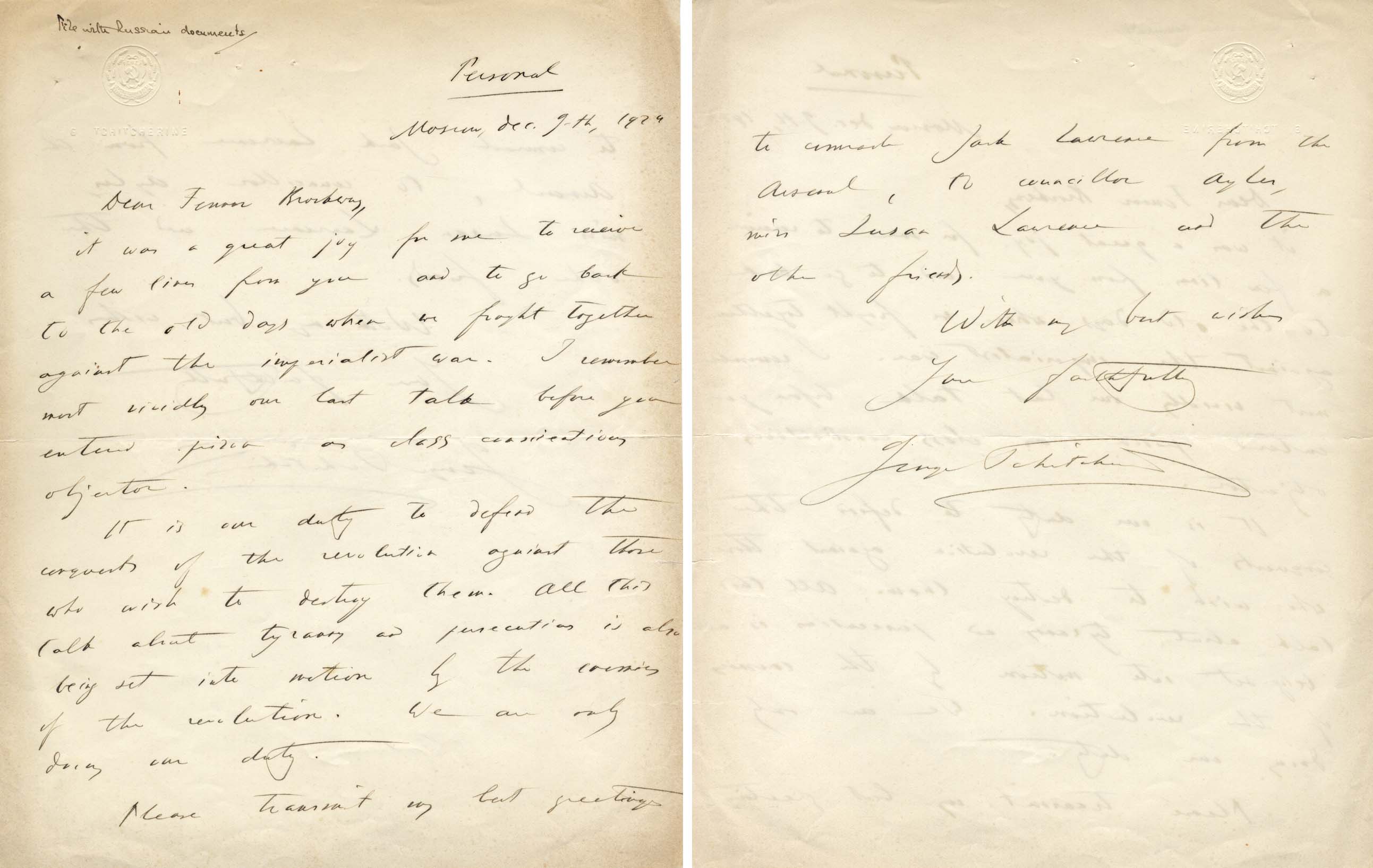
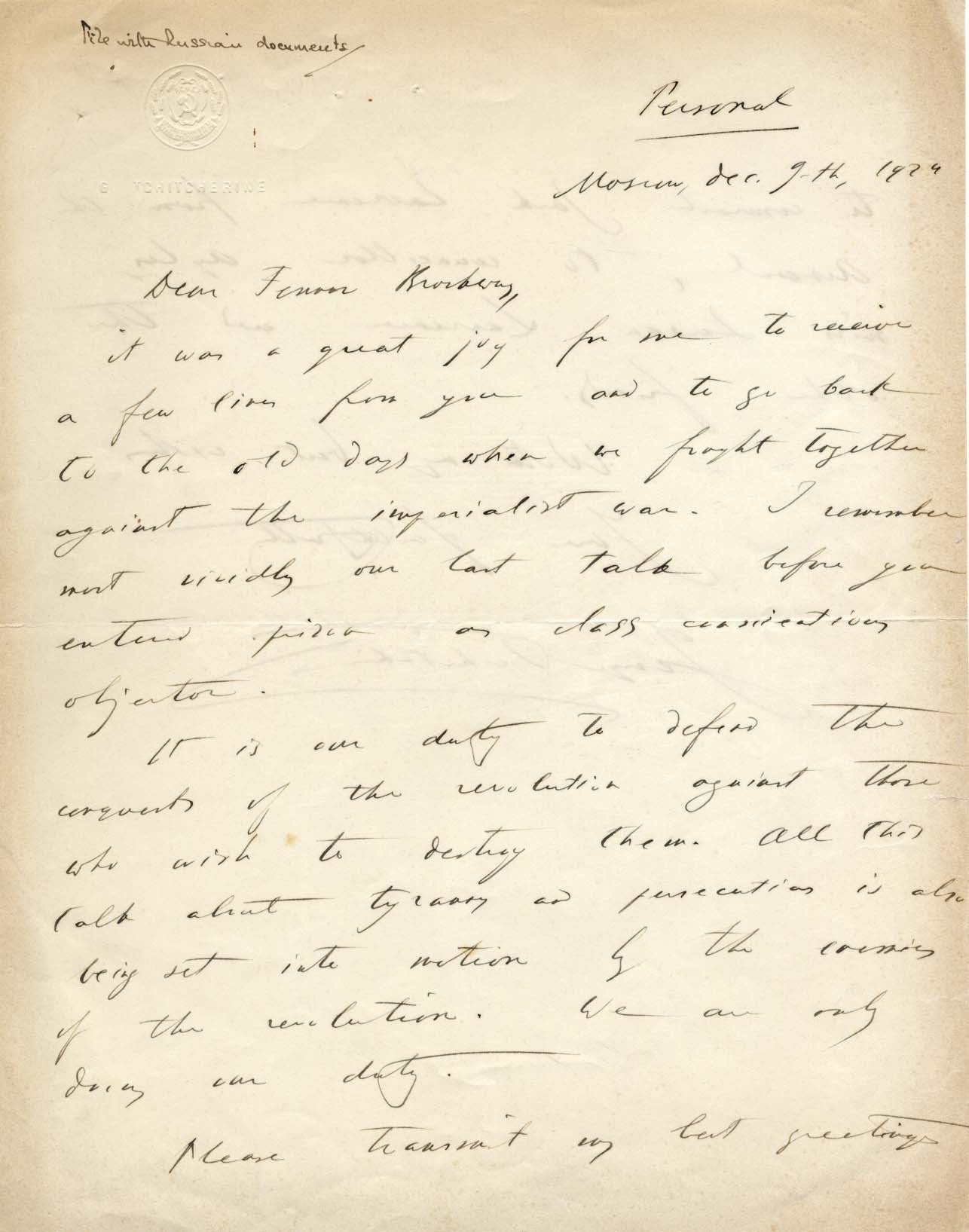
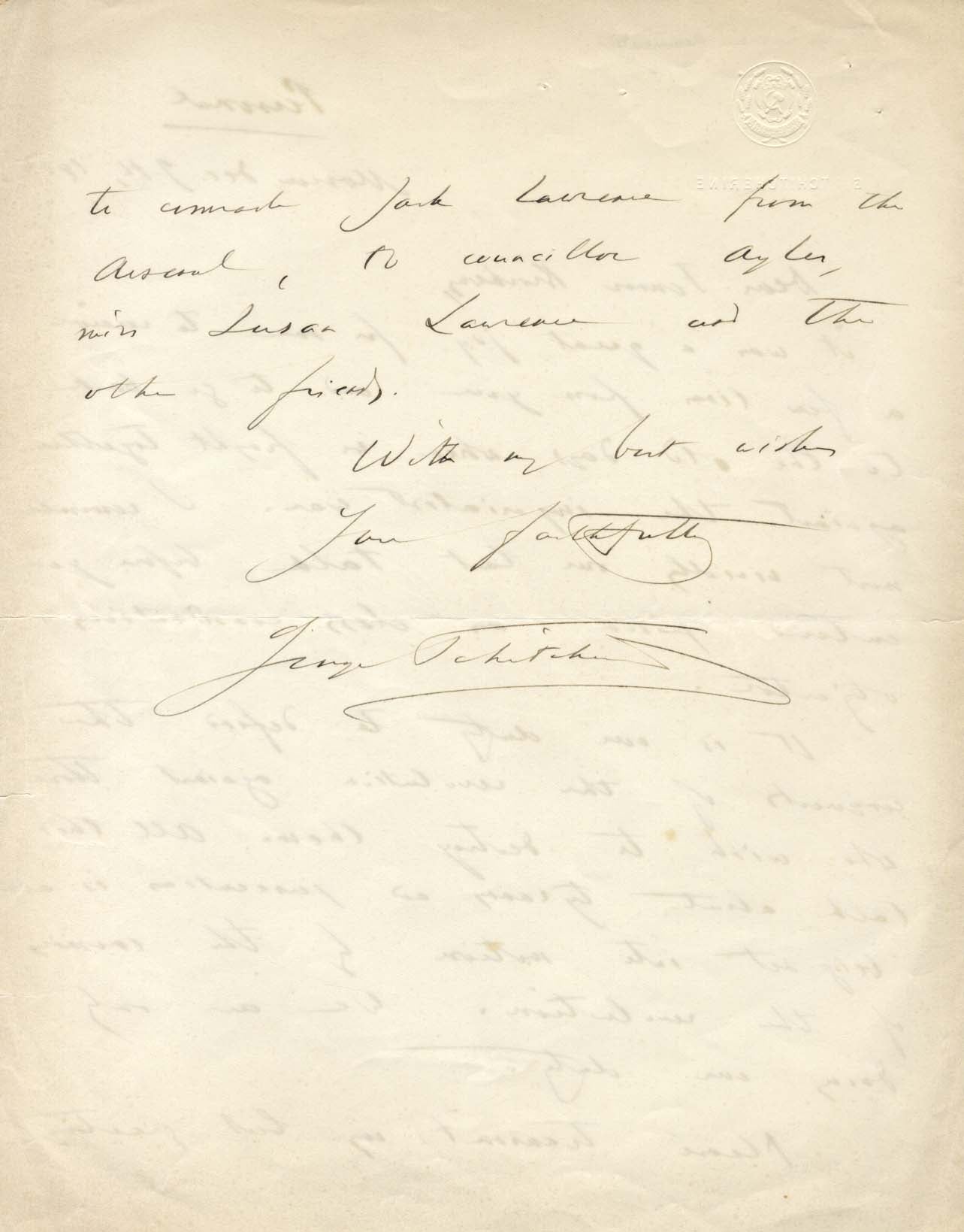
Autograph letter signed, 1 1/2 pages (both sides) - with intergral blank leaf, 8,5 x 11 inch, blind embossed stationery, Moscow, 9.12.1924, in English, reply letter to an unidentified correspondent - concerning their common struggle against the imperialist war and their "duty to defend conquests of the revolution against those who wish to destroy them", written and signed by Georgy Chicherin in black ink "George Tchicherine", with a horizontal letter fold, a few small pinholes to the upper left corner, browning and two small tears to the right edge - in fine condition.
"It was a great joy for me to receive a few lines from you and to go back to the old days when we fought together against the imperialist war. I remember most vividly our last talk before you entered prison as class conscientious objector. It is our duty to defend conquests of the revolution against those who wish to destroy them. All this talk about Tyranny and persecution is also being set into motion by the [?] of the revolution. We are only doing our duty and concluding by asking him to transmit his greetings to ‘Jack Lawrence from the Arsenal, to Councillor Ayler Miss Susan Lawrence and the other Friends.
With my best wishes
Yours faithfully - George Tchicherine"
An uncommon autograph, this letter written at the end of the year in which Joseph Stalin replaced Lenin, with Chicherin remaining prime minister
Further Information on the person
Profession:
(1872-1936) Russian Marxist revolutionary and a Soviet politician who served as the first People's Commissar for Foreign Affairs in the Soviet government from March 1918 to July 1930.
Year of Birth: 1872
Georgy Vasilyevich Chicherin was born on November 24, 1872, in an aristocratic family in Tambov, Russia. He studied law at the University of St. Petersburg and later became involved in revolutionary activities, joining the Bolshevik party in 1903.
Chicherin played a significant role in the Russian Revolution of 1917, serving as a diplomat for the Bolshevik government. He negotiated various treaties and agreements with foreign powers in an attempt to secure recognition for the new Soviet regime.
As People's Commissar for Foreign Affairs from 1918 to 1930, Chicherin was responsible for managing the Soviet Union's foreign policy during a tumultuous period of war and reconstruction. He was known for his pragmatism and diplomatic skill, often being described as a "master of ambiguity."
Chicherin's tenure as Foreign Minister was marked by his efforts to improve relations with Western powers, including the signing of the Treaty of Rapallo with Germany in 1922. However, he also faced challenges, such as the failure to gain recognition from the United States and other major countries.
In 1933, Chicherin was removed from his position as Foreign Minister and given a less prominent role in the Soviet government. He died on July 7, 1936, in Moscow, leaving behind a complex legacy as a revolutionary, diplomat, and statesman.
Despite his mixed reputation, Georgy Vasilyevich Chicherin remains a significant figure in Russian history, remembered for his contributions to the early years of the Soviet Union and his efforts to navigate its foreign relations during a turbulent period of international isolation and ideological conflict.
Certificate of authenticity
All of our pieces are sold with a Certificate of Authenticity. If a piece turns out to be wrong or if you do not like an autograph, you will get your money back for a lifetime.
Payment & Security
Your payment information is processed securely. We do not store credit card details nor have access to your credit card information.